We navigate our lives under a persistent grammatical error of the soul: we treat the most profound forces of existence—Love, Energy, and Life itself—as static nouns.
We speak of “finding” love as if it were a hidden treasure, or “losing” energy as if it were a misplaced set of keys. This linguistic habit reinforces an optical illusion of the ego, suggesting that these are objects to be acquired, stored, or depleted.
In reality, existence is not a collection of things; it is a choreography of events. Modern physics defines energy not as a “stuff,” but as the capacity to perform work—a measure of potential action. Ancient wisdom mirrors this, describing the universe not as a gallery of statues, but as a singular, continuous “Flow.”
When we peer beneath the surface of our perceived reality, we find that what we call “substance” is actually “process.” To understand our place in the cosmos, we must stop looking for objects and start observing the movement that sustains them.
1. Stop Treating Love Like a Noun
In our common vocabulary, we have fossilized the most dynamic aspects of our being. We treat Prana, Energy, and Love as if they were substances held within a container. But these forces are defined entirely by their movement. They are what they do.
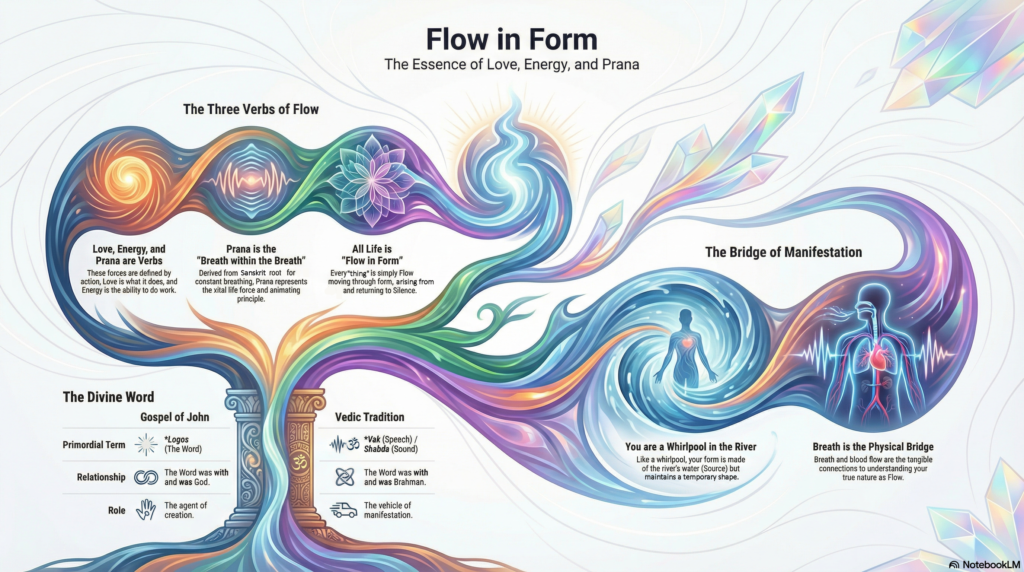
Consider the Sanskrit etymology of Prana, often translated simply as “life force.” It is composed of Pra (forth or constant) and Ana (to breathe, move, or live). It is the “Animating Principle” that moves forth without pause. It is not a thing that lives; it is the act of living itself. When we shift our perspective to see these forces as dynamic actions, we realize they are all synonyms for a singular Flow.
Love as a Verb
“Love is what it does. It is the nature of Love to Love. Love is a Verb.”
Shifting from a noun-based to a verb-based understanding fundamentally transforms our relationship with vitality. If love and energy are verbs, they are not finite resources that can be exhausted; they are processes we inhabit. Vitality is no longer a matter of hoarding a “thing,” but of maintaining the quality of our “doing.”
2. The Universal “Word” — From the Bible to the Vedas
This understanding of existence as a dynamic vibration is the Golden Thread running through the foundation of disparate spiritual systems. In both Western and Eastern traditions, the origin of the universe is described not as the sudden appearance of an object, but as the emergence of a primordial “Word.”
The Christian Logos and the Vedic Vak serve as parallel descriptions of this divine agent of manifestation.
| Gospel of John | Vedic Tradition |
|---|---|
| The Logos (The Word) was with God and was God. | The Vak (Speech) was with Prajapati and was Brahman. |
| The Word is the agent of creation: “All things were made through Him.” | Sound (Shabda) is the vehicle of manifestation; creation is a projection of vibration. |
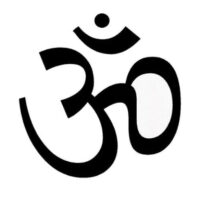
In the Indian tradition, this “Word” is identified as Om, the primordial vibration. Just as a sound emerges from silence, ripples through the air, and eventually fades back into its origin, the entire universe is viewed as a vibration projecting from a source of absolute Silence.
3. You Are a Whirlpool, Not a Statue
If all things are “Flow in Form,” we must reconsider the nature of the individual. We often imagine ourselves as statues—fixed, solid entities moving through time. But the reality is far more fluid.
A more precise metaphor is the whirlpool in a river.
To the observer, a whirlpool appears to be a distinct object with a stable shape and position. Yet, the whirlpool has no independent substance. It is composed entirely of the river’s water. It is a temporary formation—a specific pattern of “Flow in Form.”
The “BodyMind” is that whirlpool. You have no static identity separate from the river of Source, whether you call that source Love, Energy, or Prana.
You arise from the silence. You are surrounded by the silence. You return to the silence.
You are not a “thing” separate from the source; you are the source in a state of temporary, specific movement. You are the river, for a moment, remembering itself as a vortex.
4. The Practical Bridge of Breath and Blood
This is not merely abstract philosophy; it is Philosophy and Fact. This perspective requires no leap of faith, no adherence to a dogma, and no specific belief system. It demands only that you observe the physical mechanics currently sustaining your form.
The bridge between the metaphysical “Source” and your immediate reality is found in the rhythmic movement of your own body. Your circulation and your respiration are the “receipts” for the flow that defines you.
“Prana is the Breath within the Breath.”
By observing your “Breath Flow” and “Blood Flow,” you are watching the animating principle in real-time. This is the empirical evidence of your true nature: you are not a fixed identity, but a continuous movement. Your circulation is the flow of the river through the whirlpool of your form.
5. Conclusion: Returning to Silence
We are conditioned to identify as a “thing”—a person with a static name, a rigid history, and a defined boundary. But the reality is more elegant and far more fluid. You are “Flow in Form,” a beautiful and temporary vibration emerging from a deeper, silent Source. Love, Energy, and Prana are simply different names for this single, underlying movement.
To know this is not an intellectual achievement, but an act of being. You do not have to become the flow; you already are the flow.
How would your life, your labour, and your relationships change if you stopped viewing yourself as a “Thing” and finally accepted your nature as a “Verb”?
Leave a Reply