It is the nature of Love to Love
1. The Illusion of Solidity
We inhabit a world that feels deceptively firm beneath our feet, yet we often struggle to reconcile this apparent solidity with the undeniable, underlying reality of constant change.
We have been conditioned to view ourselves as fixed, “solid” entities—biological objects moving through an external environment.
However, both ancient metaphysical wisdom and the visceral reality of your own body suggest a more profound truth: you are not a static noun, but a majestic verb.
You are a localized expression of a continuous, universal current, often described in sacred texts as “Love in Form.”
By exploring your own biology as a philosophical map, you can begin to see that you are not a stationary observer of life, but the very movement of life itself.
2. Love is Not a Feeling—It’s a Verb
To understand your nature as a “flow,” we must first rescue the concept of Love from the realm of mere sentiment. In this philosophical framework, Love is not an emotion you have; it is the action that you are.
The fundamental principle of the universe is that “it is the nature of Love to Love.”
Reality is not a collection of static objects, but a singular, tireless activity. Just as a river is defined by the very act of its movement rather than the banks that contain it, Love is defined by its active, creative expression.
When the universal energy takes a specific form—such as your own life—it does not cease to be a flow; it simply becomes “localized.”
“Just as a river must move to be a river, Love is defined by its active flow.”
3. The Whirlpool Secret: Form vs. Substance
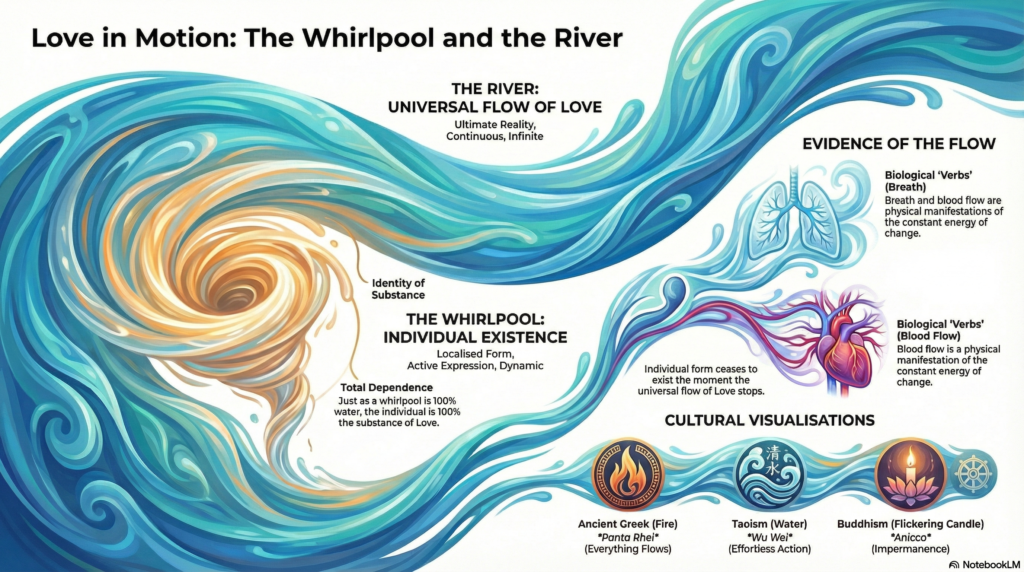
The relationship between the individual and the cosmos is most elegantly captured through the analogy of the river and the whirlpool.
This illustrates the concept of Nonduality, or “Not-Two”—the realization that Reality and how it appears are inseparable.
- Appearance vs. Reality: On the surface, our senses perceive two distinct things: a vast, linear river and a specific, spinning whirlpool. This is the “Form.” However, the “Substance” of that whirlpool is 100% river water. There is no “whirlpool water” that is distinct from “river water.”
- The Identity of Substance: While every individual form appears unique and separate, the underlying substance—the “One Substance” of every atom and cell—is the same universal Love.
- Total Dependence: This perspective reveals the startling truth of our existence: our total dependence on the universal current. If the river stops flowing, the whirlpool does not simply slow down; it instantly ceases to be. Your individual form is not a self-sustaining engine; it is the river itself whirling at a specific point in space and time.
4. Your Biology is “Internal Evidence” of the Universal Flow
The philosophy of “Love as a Verb” is not a mere abstraction; it is written into the very thrum of your pulse. Your body serves as a living laboratory, providing constant internal evidence that you are a process in motion.
- Breath Flow: Indigenous cultures, from the Plains Indians to Aboriginal Australians, visualize the breath as a manifestation of “The Great Cycle.” They reject linear time in favor of a Spiral or Circle, where ancestors are present in the land now because energy is a repeating flow. In this view, change is not something happening to the world; the rhythmic flow of the breath is the world. You do not “do” the breathing; the universal flow breathes through you.
- Blood Flow: Your circulation is a literal river of Love localized and whirling within you. Your heart sits at the center of this biological whirlpool, driving a current of the “One Substance” through every extremity. There is no part of your pulse that is separate from the energy of constant change.
“There is no flow within your body that is not the substance of Love in action.”
5. Don’t Mistake the “Debris” for the Water
If we are all composed of the same “water” (Love), why do we feel so isolated and distinct? Every whirlpool in a river inevitably catches various materials in its spin. This is the “Debris of Identity.”
We often experience profound suffering because we mistake this debris for our actual essence. This debris includes:
- Ego-driven narratives and the roles we play.
- Historical grievances and the weight of personal trauma.
- Physical traits and the inevitable signs of aging.
- Environmental “twigs, leaves, and sediment” that cling to our specific Form.
While these elements give your “Form” its unique appearance, they are not your “Substance.” Problems arise when we cling to the twigs and leaves, forgetting that we are the water carrying them. Your true self is the flow, not the sediment.
6. Joining the Lineage: Ancient Wisdom on Constant Change
By realizing you are the “Energy of Constant Change,” you step into a multi-millennial lineage of those who saw through the shimmering illusion of solidity:
- Heraclitus (Ancient Greece): The champion of Panta Rhei (Everything Flows), he famously taught that “no man ever steps in the same river twice,” for both the river and the man have changed. He pointed to Fire as his primary symbol—a process, not a thing, that only exists by consuming and changing. He called this the Logos, a hidden harmony where the “way up and the way down are one and the same.”
- Buddhism (Anicca): This tradition views the “self” as a rapid succession of “mind-moments.” Nothing has a permanent essence; instead, things exist only because of conditions that are currently meeting. Like a flickering candle that appears as a single object but is actually a continuous stream of burning gas, realizing there is no “fixed” self leads to a state of equanimity.
- Taoism (The Tao): The Tao is the organic, flowing whole of the universe. It cannot be named, for naming it “freezes” it, and the Tao is always moving. Its visualization is Water, which wears away hard stone through its softness. Practitioners strive for Wu Wei (Effortless Action)—the art of “sailing” with the wind of change rather than rowing against it.
7. Conclusion: Entering the Stream
Shifting your perspective from viewing yourself as a “static object” to the “Energy of Constant Change” is the ultimate act of liberation. When you stop protecting a fixed identity, you stop fighting the current of existence.
When you see that you are a whirlpool in the river of the universe, you finally realize that you don’t need to defend your form against the water—you are the water. By letting go of the illusion of solidity, you merge with the Great Flow. You are no longer a victim of time; you are the current itself.
As the ancient wisdom reminds us: “Individual forms appear different yet the One Substance of everything is Love.”
Leave a Reply