
Shrink Your Waist by Eating More Fiber [Audio]
We have more data than ever, yet we’ve never been more confused.
In the modern wellness landscape, we are often told that health is a math problem—a rigorous tally of calories, heart rate zones, and step counts.
This “Complexity Trap” leads to a specific kind of paralysis: the feeling that if we aren’t tracking every variable with surgical precision, we aren’t actually making progress.
However, recent clinical research suggests that our most basic assumptions about how to get fit are ripe for a rewrite.
From the shocking malleability of the 80-year-old body to the way a single sugary drink can “paralyze” your body’s satiety signals, science is moving away from the “burn” and toward the “biological.”
By translating high-level data into lifestyle strategy, we can move past information overload and into a more intuitive, evidence-based reality.
1. The Death of the Calorie Counter (The MyPlate Revelation)
For years, the gold standard for weight loss was the high-friction method of Calorie Counting (CC).
But a recent comparative effectiveness trial published via NCBI reveals that a visual, proportion-based approach is just as powerful—and far more sustainable.
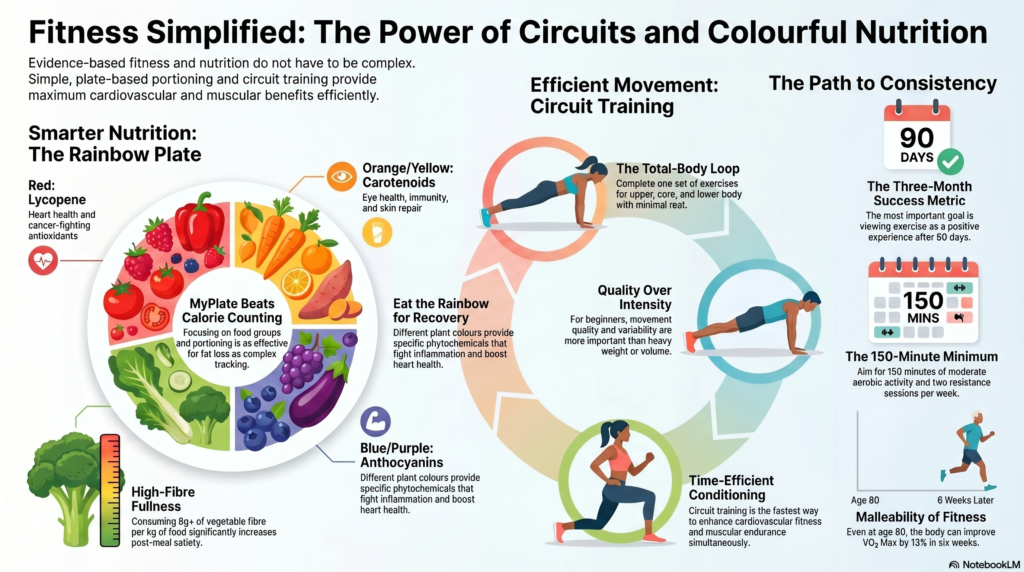
The study compared traditional calorie tracking against the “MyPlate” method, which replaces numbers with a simple visual cue: filling half your plate with fruits and vegetables, a quarter with whole grains, and a quarter with high-quality protein.
Crucially, the MyPlate icon shows fruits and vegetables occupying twice the space on the plate as grains.
The results were clear: the simpler MyPlate approach was as effective as complex tracking in reducing waist circumference.
What makes this finding profound is its accessibility.
The study focused on a predominantly low-income, Latino population—groups often underserved by high-numeracy health interventions.
By removing the barrier of “numerical literacy,” MyPlate acts as a revolutionary tool for long-term adherence.
“For a predominantly low-income, Latino patient population, the simpler MyPlate approach to reducing excess body fat may be as efficacious as the more complex traditional calorie restriction approach.” — NCBI, “Comparing Calorie Counting versus MyPlate Recommendations for Weight Loss”
2. Biological Shields: The Secret Language of Colors
“Eating the rainbow” is often dismissed as a childhood slogan, but the UPMC and FightCamp research reveals it is actually a strategy for targeted biological defense.
Plants contain phytochemicals—compounds responsible for color and smell—that act as “biological shields” for the human body.
- Red (Lycopene): A heart-health powerhouse that decreases stroke risk and defends against prostate and breast cancers.
- Orange/Yellow (Carotenoids): Essential for decreasing systemic inflammation and boosting eye health through Vitamin A conversion.
- Green (Chlorophyll & Lutein): Contains “cancer-blocking” chemicals like sulforaphane and isocyanates that inhibit carcinogens.
- Blue/Purple (Anthocyanins): These powerful antioxidants lower blood pressure and, crucially, help fight cancers of the GI tract, including the mouth, esophagus, and colon.
- White/Tan (Allicin): Found in garlic and onions, these sulfur compounds are suggested to have anti-cancer properties and keep cholesterol in a healthy range.
——————————————————————————–
The Impactful Takeaway:
Beyond general wellness, specific colors drive performance.
Anthocyanins (Blue/Purple) are critical for delaying cellular aging, while the Nitrates found in beets are a “secret weapon” for athletes, shown to increase blood flow and directly improve endurance capacity.
3. The 6-Week Miracle: Why 80 is the New 24
We often assume the window for radical physical transformation slams shut in our later decades.
Dr. Peter Attia’s analysis of a landmark cycling study shatters this myth, revealing a “staggering” level of malleability in the human system, regardless of age.
In the study, 80-year-olds and 24-year-olds underwent the same six-week aerobic program.
The data was nearly identical: both groups saw a 13% improvement in VO2 Max and a 34% improvement in maximal workload.
Most impressively, both groups experienced a 2.4-fold improvement in endurance capacity.
However, the “intensity of deconditioning” is the catch. While the 80-year-old can gain fitness as fast as a 24-year-old, they lose it much faster during periods of inactivity.
In the aging body, consistency isn’t just a virtue—it’s the primary variable for survival.
“I think you could make the case that the physical system—aerobic capacity, strength—is even more malleable than our cognitive systems… both groups improved dramatically.” — Peter Attia, MD
4. The 1953 Efficiency Hack: Why Circuit Training Still Wins
In an era of boutique fitness, the most efficient protocol remains one developed at the University of Leeds in 1953.
Research from Baylor University and the Cooper Institute confirms that circuit training is the ultimate “efficiency hack,” simultaneously enhancing cardiovascular fitness and muscle endurance.
The “overload” principle is the key here.
By shortening rest periods between stations, you are forced to lift heavier weights than you would in a high-rep endurance set.
This allows you to achieve muscle overload in just 25 to 50 repetitions per circuit.
This isn’t just anecdotal.
The investigation showed that these circuits elicit oxygen consumption values between 39% and 51.5% of VO2max, explicitly meeting the ACSM 2005 Dietary Guidelines for Americans for developing cardiorespiratory fitness.
The Lifestyle Strategy:
To apply this, stop viewing “cardio” and “weights” as separate days.
Build a circuit of complex movements (like step-back lunges and pushups), de-load the weight to focus on movement quality, and keep the station transitions rapid.
5. The “Satiety Reset”: Why Sugar Paralyzes Fiber
Weight loss failure is rarely a lack of willpower; it is usually a failure of satiety signaling.
Science points to a specific “F&V Fiber Ratio” as the body’s ultimate reset button. Consuming 9g of fiber per kilogram of solid food significantly increases feelings of fullness and resets “everyday hunger.”
Fiber fuels the gut microbial generation of short-chain fatty acids (SCFAs), which are the primary messengers for satiety.
However, this system has a “kill switch”: Sugar-Sweetened Beverages (SSBs).
The NCBI data reveals a functional paralysis: if you consume \ge100 kcal of sugary beverages daily, your body’s ability to utilize the fiber-satiety reset is effectively neutralized.
High-sugar consumers fail to increase their fiber intake over time, as sugar displaces the very foods that trigger the “fullness” signal.
“Increased short-chain fatty acids… stimulate increased satiety signaling, thereby reducing appetite.” — NCBI, “Comparing Calorie Counting versus MyPlate Recommendations for Weight Loss”
CONCLUSION: The Compound Interest of Consistency
The shift in modern health science is clear: we are moving away from “intensity and math” toward “quality and proportion.”
Whether it is prioritizing the Blue/Purple biological shields on your plate or utilizing a 1953 circuit to meet ACSM guidelines, the goal is to build a system based on compounding.
As Dr. Peter Attia’s research suggests, the body is an incredibly malleable system.
If an 80-year-old can see a 2.4-fold endurance gain in just six weeks, the potential for your health over the next three years is nearly limitless—provided you start today.
Is your current routine built for the short-term burn of high intensity, or is it designed for the long-term compounding of your biological health?
The science suggests that the “simpler” path—proportions over calories, quality over volume—is the one that actually lasts.

Leave a Reply to 5 Surprising Truths About Your Biological Reality – Cancel reply