The River Was Never Missing
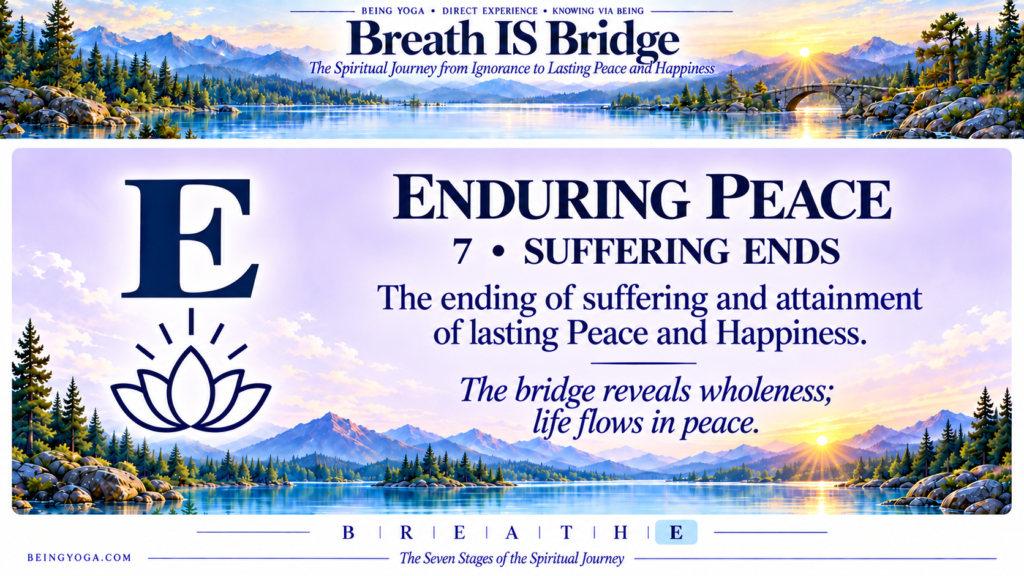
Part 7 of the BREATHE series. Stage Seven: The ending of suffering and attainment of lasting Peace and Happiness.
Months after the walk that began this series, Mara returned to the river alone.
The eddy was still there, although its outline had changed. A few leaves circled near the bank. Beyond them, the current continued beneath the bridge.
Her life had not become a sequence of serene afternoons. She had made some plans and abandoned others. Her husband still disliked discussing household repairs. Her daughter was considering a move that would take her farther away.
Yet the river no longer seemed to pose a question about what Mara needed to become.
She stood quietly, then took out her phone to photograph the light for her daughter.
Coming back to what never left
In Being Unrecognized, Mara feared that the loss of a role might mean the loss of herself. The intervening posts followed the misunderstanding into its consequences, through study, and toward direct inquiry.
The final stage of BREATHE names the peace associated with the ending of mistaken identity. Within the nondual teaching, it is the recognition of wholeness rather than the production of a new essence.
This is why the tenth traveller is such an important story. The group becomes relieved, but it does not become complete for the first time. The completeness had been overlooked.
The story of Mara offers moments in which this teaching becomes understandable in daily life. It does not measure final freedom by how pleasant a fictional person’s day has become.
The salt that could no longer be seen
In Knowing Via Being, Traverse retells Uddalaka’s teaching to Shvetaketu through salt dissolved in water. The salt cannot be recovered by looking for its former visible shape, yet its presence can be discovered through tasting.
The story redirects attention from a familiar appearance toward recognition through an appropriate way of knowing. In its Advaita setting, it belongs to the teaching expressed as Tat Tvam Asi — That Thou Art.
The point is not that a physical experiment proves every claim of nonduality. The demonstration helps the student understand why failure to find something in an expected form need not establish its absence.
Mara had expected freedom to look like a permanently improved version of herself. The teaching had gradually called that expectation into question.
Peace that need not supervise experience
Lasting Peace and Happiness, as used in this framework, concern freedom from the fundamental error of essential separation and lack. They should not be confused with maintaining one emotional state forever.
If peace required constant pleasantness, the mind would need to monitor each feeling for signs of failure. The project described in Halting the Error would begin again.
The later pages of Part 2 describe welcoming presence and a mind available for practical use without being installed as a separate identity that owns life.
This allows a useful distinction: a situation can be unfinished without essential being becoming incomplete.
Mara could miss her daughter, discuss visits, and acknowledge sadness. None required converting a move into the conclusion that she had been abandoned by life itself.
Mountains again
Part 2 closes with the familiar Zen sequence of mountains, no mountains, and mountains again. Traverse uses it to describe the movement from unquestioned identification, through its deconstruction, toward experience no longer confined by the old interpretation.
The practical world does not need to disappear. You still answer your name. You make appointments. You notice when someone is tired.
The difference concerns what the appearance is taken to mean.
For Mara, an afternoon with nothing scheduled could now be an afternoon with nothing scheduled. It did not automatically become a verdict that she was unnecessary.
She planted herbs. She helped when help was welcome. Sometimes she said no. These actions were ordinary enough to escape notice, which was part of their freedom.
The final pause and the next breath
The theme Breath IS Bridge gathers the series into a contemplative cycle. Appearance arises; interpretation may claim it; insight reveals the mistake; peace follows its ending.
Being Yoga’s The Physics of the Soul relates breath, release, and silence to the recognition of being. Here, the pause after exhalation symbolizes rest in understanding. Let the pause remain natural; it is not something to hold in order to preserve freedom.
The next breath arrives. Life continues.
The walk home
On her way back, Mara met a former colleague who asked how retirement was treating her.
“I’m learning,” she said, and asked about his family.
She did not feel compelled to deliver a polished account of herself. They spoke for a while, then continued in different directions.
Try this: Before your next ordinary task, ask, “How would I meet this if I did not need it to establish my wholeness?” Let the answer become a concrete act of care, attention, or honesty.
You Are Free!
You Are Already Whole!
Tat Tvam Asi — That Thou Art.
These are pointers to be understood, not a demand to display a spiritual mood. Revisit Truth Directly Known to explore the recognition they indicate, or return to Being Unrecognized and read the opening question anew.
Source notes: Seven Stages of the Spiritual Journey, PDF pp. 43, 52–54; Part 2, PDF pp. 51–53; Knowing Via Being, chapter 5, PDF pp. 23–25. The closing narrative is original.
Previous: H — Halting the Error
Mara and Leela are fictional characters created for this series. Traditional teaching stories are retold from the sources identified above.