The Woman Who Knew Everything Except Herself
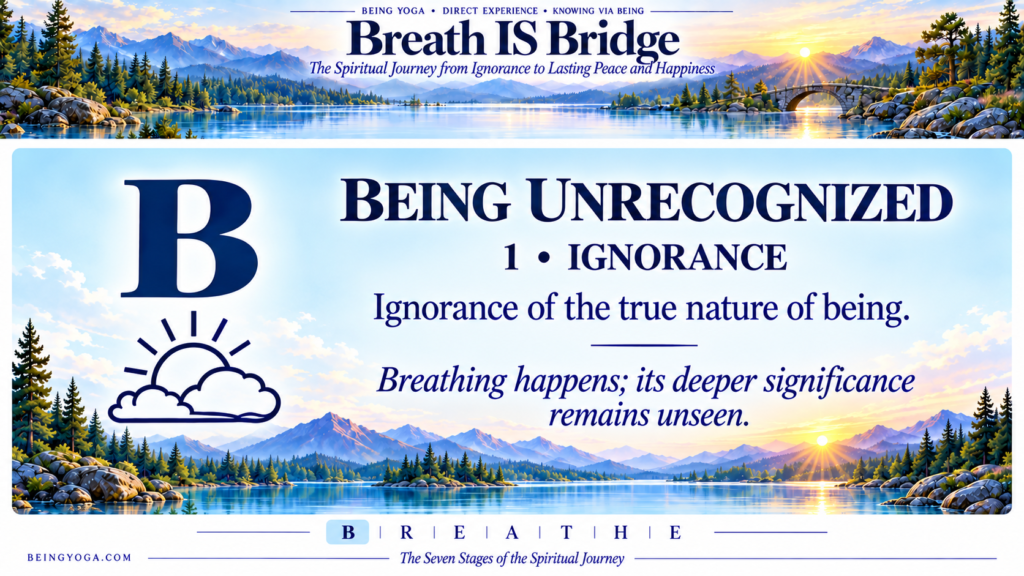
Part 1 of the BREATHE series. Stage One: Ignorance of the true nature of being.
On the morning after her retirement, Mara woke at the usual time and reached for her phone. There were no urgent messages. Nobody needed her approval before nine. For the first time in years, the day did not arrive already arranged around her usefulness.
At breakfast, her husband asked what she wanted to do.
“I don’t know,” she said.
She meant something larger than how to spend a Tuesday.
For three decades, Mara had introduced herself through her work. She knew how to be reliable, informed, and needed. Without the familiar schedule, she felt strangely undefined. Nothing essential seemed to have disappeared, yet she could not shake the feeling that something had.
Later, walking beside a river with her friend Leela, she admitted, “I know who I was. I’m not sure who I am.”
When a useful description becomes an identity
The BREATHE Framework begins here: with being that is present but unrecognized.
Ignorance, in this context, concerns our true nature. It does not mean a lack of education or intelligence. Mara’s competence was real. The question was whether competence, occupation, and personal history could fully define the one who knew them.
James Traverse’s Seven Stages of the Spiritual Journey begins by distinguishing ignorance from the error it generates. First, our essential nature is not understood. Then a limited account of identity is accepted in its place. Keeping these stages distinct helps us recognize the mechanism rather than treating every discomfort as the same problem.
A name is useful. A role is useful. The difficulty begins when a useful description is asked to provide an absolute answer.
Mara could stop being a manager. Had she stopped being?
The question sounded almost too simple. Yet she had spent the morning behaving as if the two were inseparable.
The gold that forgot it was gold
In the first Seven Stages guide, Traverse uses gold fashioned into jewellery to distinguish substance from name, form, and use. A necklace can become bangles; the bangles can become rings. Their descriptions change while the gold remains gold.
Imagine a ring worrying that being reshaped would mean the end of its essential nature. From the ring’s point of view, the concern makes sense. Its familiar outline will disappear. But the gold does not need to become gold again when the shape changes.
This is a teaching metaphor for self-inquiry. It invites us to examine whether identity has been confined to an appearance. It is not an argument that changes in human life do not matter.
Mara still needed to discover how she wanted to live. What softened was the assumption that she had to invent a new essential self before living could continue.
The river beneath the name
Leela pointed toward an eddy near the bank. Leaves circled inside it while the current moved past.
“We can name that pattern,” she said. “But could we take it home without taking water?”
Mara watched the eddy change shape around a branch.
Being Yoga’s The Noun Illusion develops a related inquiry through the whirlpool: a recognizable form need not possess an independent substance. The metaphor helps loosen the assumption that whatever can be named must exist as a self-contained thing.
The invitation is to look at the experience to which the name points.
“Retired,” “successful,” “uncertain,” and “useful” described aspects of Mara’s life. None could contain the entire actuality of this walk: water sounding against stones, cool air, the movement of breathing, the knowing of it all.
Breath before the biography
Breath is a gentle beginning because it can be noticed before it is explained. You can feel an inhalation without first deciding whether you are a successful person.
Being Yoga’s Breathing: the Link Between the Body and the Mind presents breath as a bridge between deliberate attention and the spontaneous movement of life. Here, it becomes an invitation to meet experience before reducing it to a personal account.
Let a breath arrive naturally. Notice its movement. Then notice a familiar statement about yourself.
Ask: Does this statement describe something in my experience, or does it exhaust what I am?
You do not need to replace the statement with “I am awareness.” For now, simply recognize the difference between a description and the living presence it attempts to describe.
The question Mara took home
That evening, Mara did not solve her future. She made dinner, called her daughter, and began a list of things she might enjoy.
But beside the list she wrote another question: “What was here before I became any of these things?”
This was the opening of inquiry. Her uncertainty had become an opportunity to look.
Try this: Write three sentences beginning “I am.” Notice which name a role, condition, or judgment. Without rejecting them, ask what knows each one.
The next morning, one short email would show Mara how quickly a description could become a conviction. Continue to R — Reality Misread: The Snake We Bring to the Path.
Source notes: James Traverse, Seven Stages of the Spiritual Journey, PDF pp. 6–7, 25–27; Knowing Via Being, introduction, PDF pp. 3–4. River application and Mara narrative are original.
Mara and Leela are fictional characters created for this series. Traditional teaching stories are retold from the sources identified above.