More Than a Breath
To the uninitiated, the diaphragm is a simple bellows—a thin, dome-shaped musculotendinous partition separating the thoracic and abdominal cavities.
However, in the realm of high-performance integrative physiology, we recognize it as the fulcrum of the human “network of breathing.” T
his uniquely mammalian evolutionary trait is a biological marvel; in an average lifetime, your diaphragm will contract nearly one half-billion times.
Far from being a single-purpose organ for gas exchange, the diaphragm is the hidden architect of your systemic well-being, influencing everything from spinal integrity to fluid dynamics and neurological signaling.
1. It’s the “Invisible Anchor” for Your Spine
The diaphragm is quite literally The Overlooked Core Muscle.
While traditional fitness culture obsessively targets the visible abdominals, the diaphragm provides the internal stiffness necessary to unload the spine during movement.
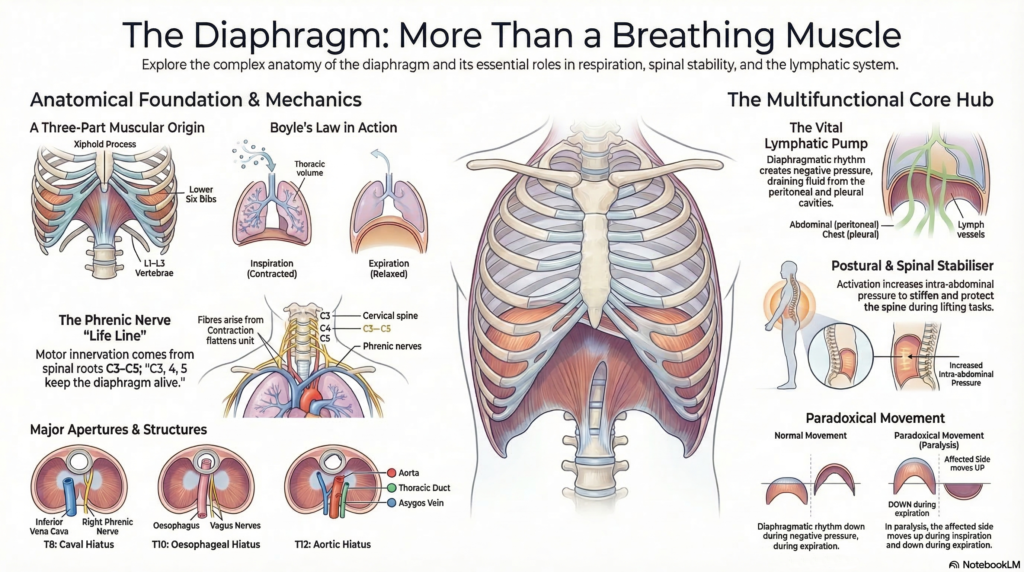
Anatomically, its fibers blend with the anterior longitudinal ligament and attach directly to the L1-L3 vertebrae via the musculotendinous crura.
The key to its stabilizing power lies in the Zone of Apposition (ZOA)—the area where the diaphragm’s fibers run vertically, parallel to the inner rib cage.
When the diaphragm contracts and descends, it increases intra-abdominal pressure (IAP), turning the abdomen into a “firm pillar” that prevents spinal buckling.
Typical “ab workouts” often fail because they emphasize external tension while neglecting the ZOA and the pressure-regulating role of the glottis.
Sophisticated athletes, such as tennis players, utilize a partially open glottis—often heard as a grunt—to maintain this internal pressure, thereby enhancing balance and stability during high-impact movement.
As the founder of osteopathy, Andrew Still, eloquently stated:
by (diaphragm) action we live, and by its failure we shrink, or swell, and die.
2. The “Blood Thief” Mechanism Behind Chronic Back Pain
A weak diaphragm does more than limit your aerobic capacity; it can actively compromise your spinal health through a process called blood shunting.
Because oxygen for breathing is a “non-negotiable priority” for survival, the central nervous system (CNS) will prioritize blood flow to the diaphragm over any other skeletal muscle during periods of fatigue.
When the diaphragm is weak, it tires prematurely, prompting the CNS to “steal” blood from the erector spinae (back muscles).
This is catastrophic for coordination because muscle spindles—the sensory organs that provide position sense or core proprioception—are highly vascular and exist primarily in slow-twitch fibers.
When blood flow drops, these spindles lose sensitivity, and your brain loses the ability to “feel” your spine’s position.
In a landmark experiment, researchers used vibrating motors on the calves of subjects balancing on foam pads.
Healthy individuals used their core to filter out the “illusion” of lengthening muscles created by the vibration.
However, those with a fatigued diaphragm shifted to an ankle-steered balance strategy, swaying excessively because their back spindles had effectively “gone dark.”
Strengthening the breath is often the first step in restoring spinal proprioception.
3. Your Body’s Most Powerful Fluid Pump
The diaphragm serves as the engine for the Thoracic Pump, a critical mechanism for venous return and lymphatic drainage.
This function is facilitated by three major openings, which clinical professionals remember by the “Rule of 8, 10, 12”:
- Caval hiatus (T8): Transmits the inferior vena cava, which the diaphragm squeezes during descent to force blood toward the heart.
- Esophageal hiatus (T10): Transmits the esophagus and vagus nerves.
- Aortic hiatus (T12): Transmits the aorta, azygos vein, and the thoracic duct.
Beyond circulation, the diaphragm is a literal “cleansing pump.”
Approximately 60% of the body’s lymph nodes are situated just beneath it.
The muscle contains stomata—porous discontinuities that act as drainage gates for the peritoneal cavity.
Notably, these stomata are significantly more abundant on the peritoneal (abdominal) side than the pleural side, making the diaphragm the primary regulator of abdominal fluid turnover.
4. The “Shoulder-Pain” Illusion
The diaphragm is a master of neurological disguise. It is primarily innervated by the phrenic nerve, which originates from the C3-C5 segments of the spinal cord.
Because these same spinal segments supply the skin of the shoulder via the supraclavicular nerves, the brain often misinterprets diaphragmatic distress as a “shoulder injury.”
This phenomenon of referred pain is a common medical mystery solved.
Irritation of the diaphragmatic pleura or peritoneum—whether from blood (as in a ruptured spleen or ectopic pregnancy), gas (post-laparoscopy), or inflammation—is frequently felt as sharp pain in the shoulder tip.
This complex wiring demonstrates that an issue seemingly localized to the shoulder may actually be a distress signal from the “network of breathing.”
5. The Gatekeeper of Your Digestive Health
The diaphragm is essentially “two muscles in one,” with the costal part handling respiration and the crural part managing digestion.
The crural fibers surround the esophageal hiatus, forming a vital anti-reflux barrier.
This physiological sphincter is a sophisticated guardian.
It coordinates with the esophagus during swallowing or vomiting, but its primary job is to provide tension during inspiration.
This ensures that the pressure changes required to draw air into the lungs do not simultaneously pull stomach acid into the esophagus.
Without this specialized gatekeeper, every deep breath would be a risk factor for gastroesophageal reflux.
Conclusion: The Future of the Functional Core
The diaphragm is not merely a muscle for survival; it is the linchpin of human performance.
Emerging clinical research into Inspiratory Muscle Training (IMT) confirms that by specifically strengthening this muscle, we can improve core proprioception, reduce the severity of low back pain, and shift the body away from unstable, ankle-steered balance strategies.
If your next “core workout” involved only your breath, how would your posture change by tomorrow?

Leave a Reply