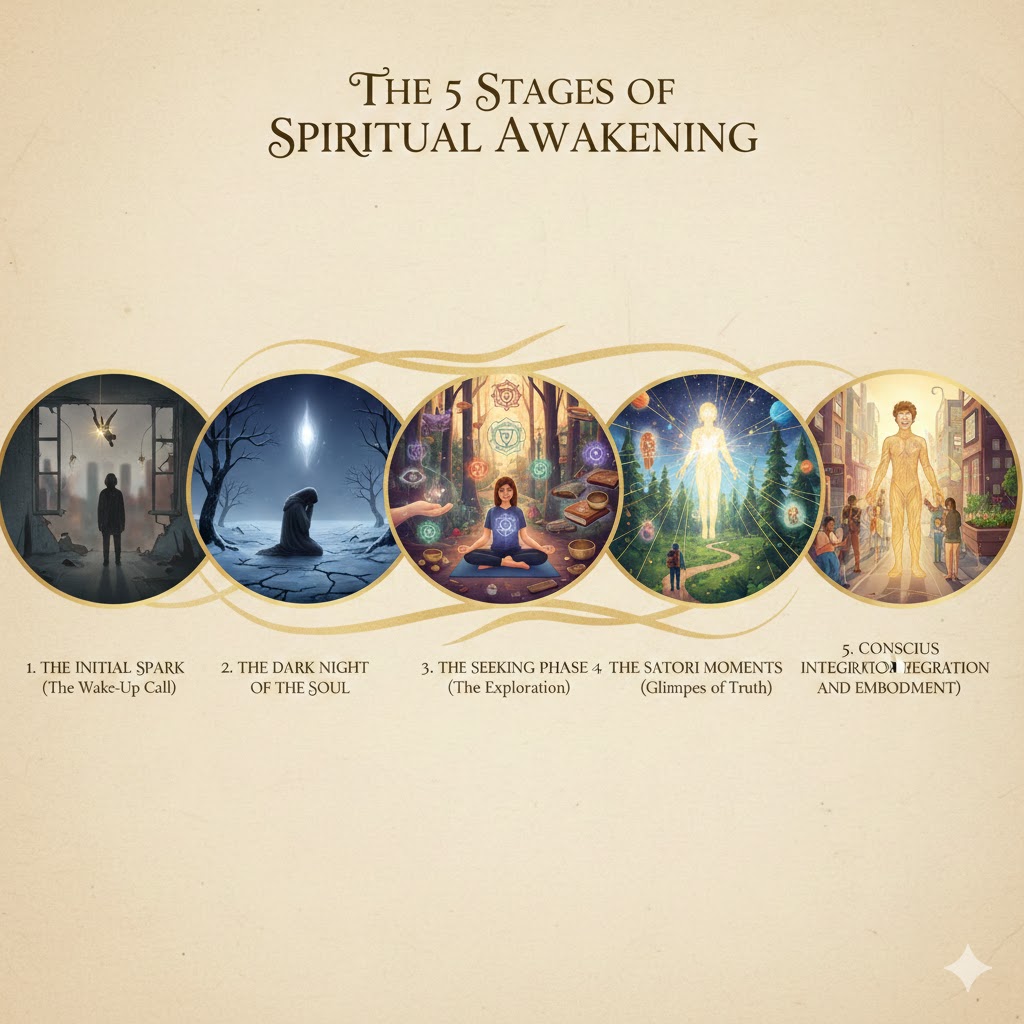
Spiritual awakening is not a destination, but a profound process of shedding old identities to uncover your authentic self. While every journey is unique, most seekers navigate a series of predictable phases as they shift from “ego-consciousness” to “soul-consciousness.”
Key Takeaways
- Non-Linear Process: You may move back and forth between stages; it is rarely a straight line.
- The “Dark Night”: Emotional upheaval is a natural part of the purging process.
- Integration is Goal: The final stage is about living spiritually in the physical world, not escaping it.
- Individual Timing: There is no “correct” speed for awakening.
1. The Initial Spark (The Wake-Up Call)
This stage often begins with a sense of “is this all there is?” You might experience a sudden life crisis (loss, illness) or a gradual feeling of emptiness. The external world begins to lose its luster, and you start questioning long-held beliefs.
2. The Dark Night of the Soul
This is the most challenging phase. As the ego begins to dissolve, you may feel lost, depressed, or isolated. This “spiritual winter” is necessary to clear away the illusions of the old self to make room for the new.
3. The Seeking Phase (The Exploration)
Once the old structures have crumbled, curiosity takes over. You might experiment with:
- Meditation and Yoga
- Energy Healing (Reiki, Sound Baths)
- Metaphysical texts and philosophy
- Connecting with nature
4. The Satori Moments (Glimpses of Truth)
A “Satori” is a moment of sudden enlightenment. You feel a deep sense of oneness with the universe. While these moments are often temporary, they provide the “fuel” and conviction needed to continue the journey.
5. Conscious Integration and Embodiment
This is where the “work” happens. It’s the process of bringing your spiritual insights into your daily life—your job, your relationships, and your habits. You move from knowing truth to being truth.
Comparison of Ego-Consciousness vs. Soul-Consciousness
| Feature | Ego-Consciousness | Soul-Consciousness |
| Primary Driver | Fear and Security | Love and Growth |
| View of Others | Separate / Competition | Connected / Reflection |
| Validation | External (Status, Money) | Internal (Peace, Alignment) |
| Reaction to Pain | Resistance and Victimhood | Acceptance and Lesson-seeking |
People Also Ask Regarding: The 5 Stages of Spiritual Awakening
How long does a spiritual awakening last? It is a lifelong process. While the “acute” phases (like the Dark Night) may last months or years, the expansion of consciousness continues indefinitely.
Can I trigger a spiritual awakening? While you cannot force it, you can create the “soil” for it through practices like mindfulness, shadow work, and spending time in silence.
Is spiritual awakening the same as religion? No. While many find awakening through religion, spiritual awakening is a personal experience of connection to the Divine or Universal Intelligence, often transcending specific dogmas.
Summary
The stages of spiritual awakening—from the Initial Spark to Conscious Integration—represent the soul’s evolution. It is a journey of unlearning who you were told to be so you can finally remember who you truly are. Though the “Dark Night” can be painful, it leads to a life of profound peace, purpose, and interconnectedness.
During the Seeking Phase, your mind is hungry for answers, which can sometimes lead to “spiritual overwhelm.” This plan is designed to ground your energy while opening your intuition, helping you move from intellectual curiosity to lived experience.
Preparation
- Time: 10–15 minutes daily.
- Space: A quiet spot where you won’t be interrupted.
- Tool: A journal to jot down insights immediately after.
The 7-Day Roadmap
| Day | Focus | Meditation Technique | Purpose |
| 1 | Grounding | Rooting Visualization: Imagine roots growing from your spine into the earth. | To stabilize the nervous system after the “Dark Night.” |
| 2 | The Observer | Thought Labeling: Quietly note thoughts as “planning,” “memory,” or “feeling.” | To realize you are the consciousness behind the thoughts. |
| 3 | Body Wisdom | Somatic Scan: Move attention slowly from toes to crown, noticing tension. | To reconnect with the physical vessel of your spirit. |
| 4 | Heart Opening | Loving-Kindness (Metta): Silently send “peace” to yourself and others. | To shift the search from the analytical mind to the heart. |
| 5 | Silence | Pure Stillness: Sit without a guided voice or music. Focus only on breath. | To build comfort with the “void” where true insights live. |
| 6 | Intuition | Third Eye Focus: Gently focus your internal gaze between your brows. | To activate your internal guidance system. |
| 7 | Expansion | Oneness Breath: Inhale “Universe,” exhale “Self” until the line blurs. | To experience a “Satori” glimpse of interconnectedness. |
3 Tips for Success
- Don’t Force “Quiet”: The goal isn’t to stop thinking; it’s to stop identifying with the thoughts. If your mind is busy, just notice that it’s busy.
- Consistency Over Intensity: Ten minutes every day is more transformative for your brain than two hours once a week.
- The “After-Glow”: Stay in your seat for 60 seconds after you open your eyes. This helps bridge the gap between your meditation and the “real world.”
Key Takeaways for Seekers
- Discernment is Key: You don’t have to believe everything you read or feel.
- The Body is the Compass: If a practice makes you feel constricted, it might not be for you right now. If it feels expansive, follow it.
- Integration: Use your journal to track patterns. You’ll likely notice that your “random” insights on Day 3 connect to your experiences on Day 6.
7-Day “Seeking Phase” Journaling Guide
To get the most out of your 7-day meditation plan, use these prompts immediately after your practice. Writing helps translate abstract spiritual energy into concrete personal insights.
| Day | Meditation Focus | Journaling Prompt |
| 1 | Grounding | What areas of my life feel “shaky” or unstable right now? What is one physical activity that makes me feel safe and present? |
| 2 | The Observer | Describe the “voice” of your ego today. Was it critical, anxious, or busy? How does it feel to know you are the one listening to that voice? |
| 3 | Body Wisdom | Where in my body do I hold the most tension? If that tension had a message or a single word for me, what would it be? |
| 4 | Heart Opening | Who is the hardest person for me to send “peace” to right now (including myself)? What does that resistance tell me about my current boundaries? |
| 5 | Silence | What was the most uncomfortable part of the silence today? What did I try to distract myself with when things got quiet? |
| 6 | Intuition | List three times in the past where my “gut feeling” was right. What did that physical sensation feel like compared to a logical thought? |
| 7 | Expansion | If I lived every day from a place of “Oneness” and connection, what is the first major change I would make to my daily routine? |
Tips for Deep Reflection
- The “Stream of Consciousness” Rule: Try to write for at least five minutes without lifting your pen. Don’t worry about grammar or making sense; let the “seeker” within speak freely.
- Date Your Entries: Looking back at these in six months will provide incredible proof of your growth.
- Be Radically Honest: This journal is for your eyes only. Spiritual growth happens fastest when we stop performing for an imaginary audience.
Summary of the Process
By combining meditation (quieting the mind) with journaling (engaging the mind), you create a feedback loop that accelerates the integration phase of your awakening. You aren’t just seeking new information; you are uncovering your own inner wisdom.
Understanding the Shadow
Moving through the Dark Night of the Soul requires courage because it involves looking at the parts of yourself you’ve spent a lifetime hiding, denying, or rejecting. This is “Shadow Work“—the process of bringing the unconscious into the light of awareness.
The “Shadow” is a term coined by psychologist Carl Jung to describe the disowned parts of our personality. During a spiritual awakening, these shadows often rise to the surface as anxiety, triggers, or intense emotional discomfort.
3 Transformative Shadow Work and Dark Night Exercises
1. The Mirror Projection Technique
This exercise helps you identify shadows by looking at your “triggers” in others.
- The Practice: Think of someone who deeply irritates or upsets you. List 3 specific traits they have (e.g., “They are arrogant,” “They are selfish”).
- The Inquiry: Ask yourself, “In what way do I possess these traits, or in what way have I suppressed my right to be this way?” * The Goal: To realize that what we judge in others is often a repressed part of ourselves seeking expression or healing.
2. Dialogue with the “Darkness”
Instead of pushing away “negative” emotions like grief or rage, personify them to understand their purpose.
- The Practice: Choose a heavy emotion you are feeling. Give it a shape, a color, or a name.
- The Inquiry: Write a letter to this emotion asking:
- What are you trying to protect me from? 2. What do you need from me right now to feel safe?
- The Goal: To move from resisting the emotion to witnessing it, which allows the energy to finally move through you.
3. Rewriting the “Core Wound”
We all carry a central “story” that causes us pain (e.g., “I am not enough” or “I am unsafe”).
- The Practice: Identify your most recurring negative thought during this Dark Night.
- The Inquiry: Trace it back to its earliest memory. Is this story 100% true today?
- The Goal: To decouple your identity from your trauma. You are the witness of the story, not the story itself.
Comparison: Resistance vs. Integration
| Approach | Resistance (Staying Stuck) | Integration (Moving Through) |
| Reaction to Pain | “Why is this happening to me?” | “What is this trying to show me?” |
| Emotional Habit | Numbing (Social media, food, etc.) | Sitting with the discomfort. |
| Perspective | Seeing the shadow as “bad.” | Seeing the shadow as a “lost child.” |
Key Takeaways regarding Shadow Work and Dark Night
- It’s a Purge: The pain isn’t a sign of failure; it’s the “spiritual toxins” leaving your system.
- Self-Compassion: You cannot heal what you hate. You must be a gentle parent to your shadow.
- Nature as a Healer: When the shadow feels too heavy, physically touch the earth or walk among trees to discharge the energy.
Shadow Work Summary
Shadow Work is the “heavy lifting” of spiritual awakening. By facing your projections, dialoguing with your pain, and questioning your core wounds, you transform the Dark Night into a dawn of self-acceptance.
When you are in the thick of a spiritual awakening—especially during the Dark Night of the Soul—your “energetic plumbing” is being upgraded. This can manifest as physical exhaustion, brain fog, or extreme sensitivity to your environment.
To sustain this transition, you must treat your body as a sacred temple that is currently under renovation.
High-Vibration Lifestyle Habits
| Pillar | Habit | Why it Works |
| Nutrition | Grounding Foods | Root vegetables (carrots, sweet potatoes) and proteins help anchor your energy when you feel “spacey.” |
| Environment | Digital Detox | Reducing blue light and social media noise prevents “empathic overload” and ego-comparison. |
| Physical | Salt Baths | Epsom salt or sea salt helps clear the stagnant “auric debris” released during shadow work. |
| Biological | Circadian Alignment | Sunlight exposure within 30 minutes of waking regulates cortisol, which is often spiked during awakening. |
| Hydration | Structured Water | Staying hydrated facilitates the electrical shifts occurring in your nervous system. |
1. Master Your Sensory Input
During awakening, your senses become heightened. You may find loud noises, bright lights, or crowded places suddenly unbearable.
- The Habit: Practice “Sensory Fasting.” Spend 20 minutes a day in complete silence and darkness (or eyes closed).
- The Result: This gives your overstimulated nervous system a chance to recalibrate and prevents “ascension burnout.”
2. Move Energy, Don’t Just Exercise
Standard high-intensity workouts might feel too draining right now. Focus on movement that moves Qi (energy).
- The Habit: Switch to Yin Yoga, Qi Gong, or mindful walking.
- The Result: These practices help shift the emotional “blocks” that shadow work uncovers, preventing them from manifesting as physical aches.
3. Cultivate “High-Vibe” Boundaries
Your energy is a finite resource. In the seeking phase, you may realize certain relationships or habits no longer “match” your frequency.
- The Habit: Practice the “Elegant No.” If an invitation feels like a heavy “ugh” in your gut, decline it without over-explaining.
- The Result: You preserve your energy for the internal transformation that matters most.
Questions Regarding: Energy and Awakening
Why am I so tired even when I sleep 8 hours? Spiritual awakening is metabolically expensive. Your brain and spirit are processing deep-seated patterns. Honor the fatigue; it is a sign of deep internal restructuring.
Does “High-Vibration” mean I have to be happy all the time? No. High vibration is about authenticity. Suppressing sadness actually lowers your vibration. Allowing yourself to cry when you need to is a high-vibration act because it is an act of truth.
High-Vibration Lifestyle Habits Summary
Supporting your spiritual journey with high-vibration habits—like eating grounding foods, protecting your peace, and moving your energy—ensures that your body can keep up with your soul’s expansion. You are building the container that will eventually hold your higher consciousness.
Spiritual Awakening Toolkit
I’ve created your Spiritual Awakening Toolkit list! It includes essential books for each stage, healing frequencies for your meditation practice, and crystals to help ground and protect your energy.
- The Power of Now by Eckhart Tolle (The Wake-Up Call)
- The Untethered Soul by Michael Singer (The Seeking Phase)
- Dark Night of the Soul by St. John of the Cross (The Dark Night)
- Knowing Via Being: Self-Realization Made Simple by James Traverse [Insight]
- 432 Hz: Universal Harmony/Healing
- 528 Hz: DNA Repair/Transformation
- Black Tourmaline: Protection & Grounding during the Dark Night
- Amethyst: Intuition & Spiritual Connection during the Seeking Phase
Leave a Reply