Prana, the Energy of Constant Flow, is the Ultimate Element.
This post explores the intersection of ancient spiritual traditions, modern science, and sustainable design. One primary focus is Kundalini yoga, detailing the systematic awakening of dormant energy through chakras and nadis to achieve higher consciousness.
Complementary texts examine Buddhist ecology and Kashmiri Saivism, highlighting how spiritual philosophies promote a non-dualistic connection between the human self and the natural environment. Scientific perspectives validate these traditions by measuring the physiological effects of meditation and energy work on the nervous system.
Finally, a design thesis applies these concepts of interconnectivity to create eco-friendly, bio-based materials like cellulose foam for climate adaptation. Collectively, the texts advocate for a holistic transformation of human awareness to address spiritual, physical, and environmental crises.
How do different schools of Indian philosophy view the relationship between the observer and the observed?
Prana as the Energy of Constant Flow is the Ultimate Element
Prana and the Four Penultimate Elements
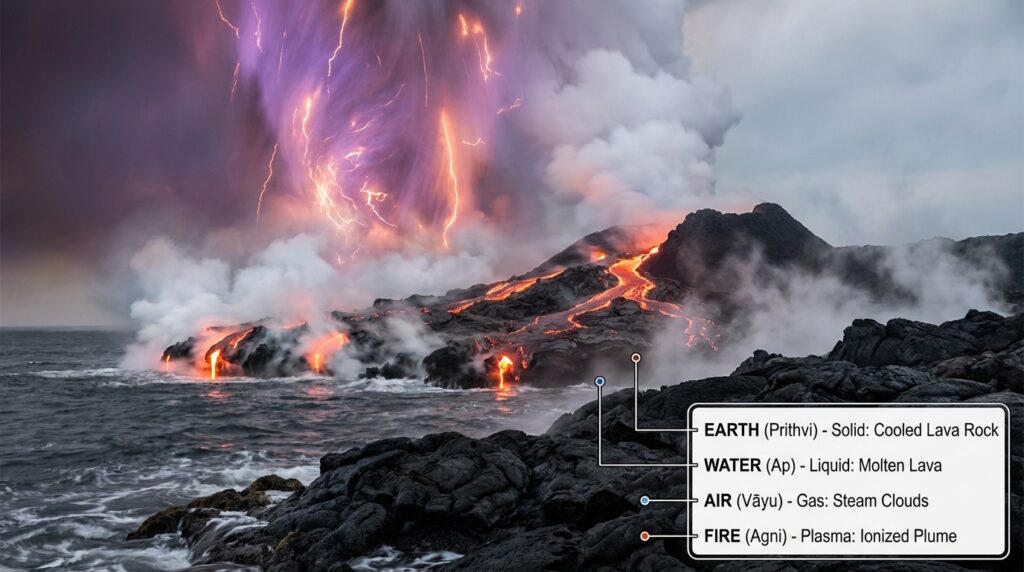
The Four Penultimate Elements, which are derivatives of Prana, are Fire, Air Water and Earth that correspond to the Four Forms of Matter as Fire-Plasma, Air-Gas, Water-Liquid and Earth-Solid
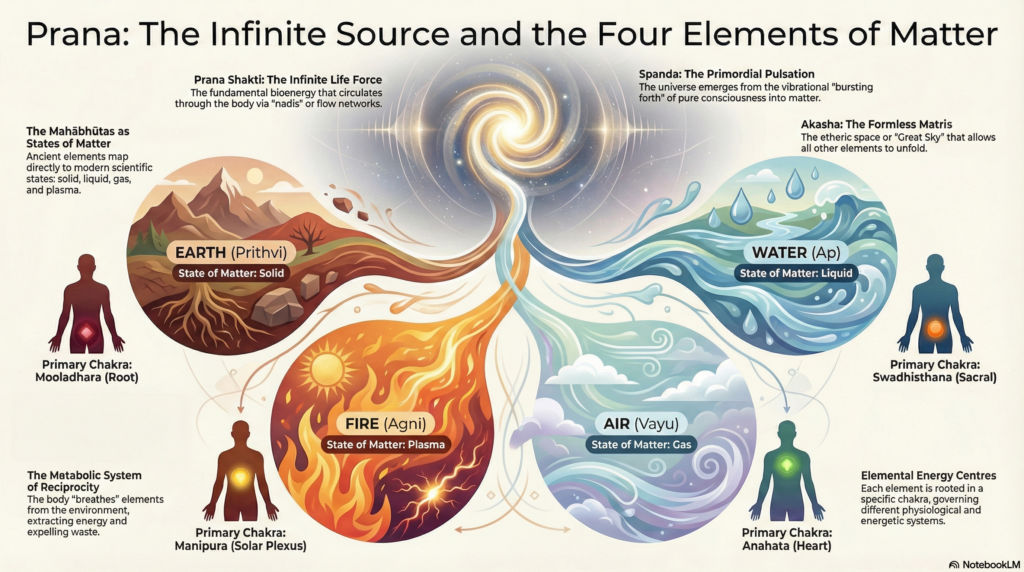
Prana is defined as the infinite life force or bioenergy that serves as the fundamental substratum of the material universe. Often described as the energy of constant flow, Prana (as prana shakti) and its mental counterpart (manas shakti) circulate through every part of the physical and subtle body via networks known as nadis, a word which literally means “flow”.
In yogic and Tantric cosmology, this ultimate energy is the source from which the four primary elements—Fire, Air, Water, and Earth—manifest, acting as “congealed” or “contracted” forms of pure consciousness.
These elements, known as the mahābhūtas, represent the five fundamental aspects of physical reality and correspond directly to specific forms of matter. Within this framework, the elements are defined by their sensory qualities rather than just their substance:
• The Earth element (pathavī-dhātu) represents solidity and attractive forces, corresponding to the solid state of matter.
• The Water element (āpa-dhātu) signifies liquidity and relative motion, mirroring the liquid state.
• The Air element (vāyu-dhātu) represents the quality of expansion and repulsive forces, aligning with the gaseous state of matter.
• The Fire element (teja-dhātu) represents heat or energy, which in a modern scientific context is the defining characteristic of plasma.
Beyond these four, a fifth element, Space or Ether (ākāsa-dhātu) or Formless Prana is described as the matrix or “Great Sky” that provides the room for the other four elements to unfold. This ancient vibrational ontology finds a parallel in quantum field theory, which posits that matter and energy are not separate entities but excitations and vibrational modes of underlying universal fields.
Ultimately, the transition from the Formless Prana to the multi-formed physical world is understood as a reflexive process of projection.
Consciousness projects its own light onto the “mirror” of its own nature, creating the abhasas (manifestations) that we perceive as distinct elements and objects, even though they remain fundamentally identical to their source.
This continuous pulsation of creation and dissolution ensures that every solid, liquid, gas, or plasma remains an active vibration of the ultimate element, Prana.
How does the Fire element link to the plasma state?
Is the Space element also considered a derivative of Prana?
What role do the five Mahābhūtas play in human biology?
Spanda
Prana is defined as the infinite life force or bioenergy and is synonymous with Spanda, the primordial pulsation or vibration of consciousness that serves as the fundamental substratum of the material universe.
This ultimate energy is described as an unmanifest flow or potential, often likened to the “Great Sky” or Akasha, which provides the etheric space or matrix required for the entire cosmos to emerge.
In its highest state, this potential exists as a pure noetic plenum or a “void of totality,” where all future manifestations are held in a state of unexpressed intention before they “burst forth” into the boisterous activity of the visible universe.
The penultimate elements—Fire, Air, Water, and Earth—are understood in this framework not as independent substances but as discrete vibrations or “congealed” forms of the underlying Prana.
Known as the mahābhūtas, these four elements represent specific vibrational modes or “condensed” expressions of the absolute, assuming tangible qualities through a process of contraction and self-limitation.
These elements correspond directly to the fundamental forms of matter, where Fire represents the quality of heat or plasma, Air represents expansion or gases, Water signifies liquidity, and Earth represents solidity.
The transition from the formless, unmanifest potential of Prana to the multi-formed physical world is described as a reflexive process of projection, where Consciousness projects its own light onto the “mirror” of its own nature.
This manifested universe functions as a single, unified whole—a “single radiant picture” or “one song” where every atom is inextricably threaded through an intricate web of delicate conscious vibrations.
Ultimately, the entire cosmos is recognized as the blissful play of Consciousness, ensuring that every solid, liquid, or gas remains an active and identical vibration of the ultimate element, Prana.
How does Prana differentiate between physical matter and biological life?
The human form is understood in the yogic tradition not as mere matter, but as a dynamic ensemble of energy and elements where every cell is charged with the infinite, formless life force known as Prana.
This physical body is a microcosmic reflection of the macrocosmic universe, structured by the same tattwas (principles of creation) that give shape to all manifest reality.
Within this ensemble, the Ultimate Element, Prana Shakti, acts as the fundamental substratum that flows through a complex network of 72,000 nadis to maintain the rhythms of the organism.
The four penultimate elements are breathed as substances from outside the body are inhaled, drank, eaten, and absorbed. The energy of these elements flow via the passageways of the body where their energy is absorbed and the wastes are expelled; this flow or Prana is called the Life Force.
These four penultimate elements knows as the mahābhūtas—manifest within the human structure as distinct vibrational states associated with the primary energy centres or chakras:
• Earth (Prithvi): Representing solidity and attractive forces, it is rooted in the Mooladhara chakra.
• Water (Ap): Representing liquidity and relative motion, it governs the reproductive and urinary systems via the Swadhisthana chakra.
• Fire (Agni): Representing heat and digestive energy, it radiates dynamism from the Manipura chakra.
• Air (Vayu): Representing expansion and movement, it is the subtle force within the Anahata chakra.
A fifth element, Prana, [which is not strictly speaking an element] Space or Ether (Akasha), provides the matrix for these elements to interact and is associated with the Vishuddhi chakra at the throat.
Breathing serves as the living means of connecting with this complex ensemble, acting as a bridge between the gross physical body and the subtle layers of consciousness.
Through the science of Pranayama, the practitioner does not merely perform “breathing exercises” but actively creates yogic fire to heat and awaken the dormant potential within the elements.
By mastering Swara Yoga (the science of the breath cycle), an individual can monitor the flow of ida and pingala—the mental and vital forces—to ensure they are balanced.
This conscious regulation of the breath is the primary method for forcing Prana into the central channel (sushumna), effectively purifying the tattwas and transforming the human form from crude matter into a vibrant vessel of supreme illumination.
Prana (as prana shakti) is the infinite life force or bioenergy that constitutes the fundamental substratum of the entire material universe
Behind all forms of matter and mind lies this energy, and the physical world is understood as a “congealed” or “contracted” form of pure Consciousness.
Within this vibrational ontology, the four penultimate elements (mahābhūtas) serve as the basic states of coalesced energy, representing the fundamental aspects of physical reality.
These elements correspond directly to specific forms of matter:
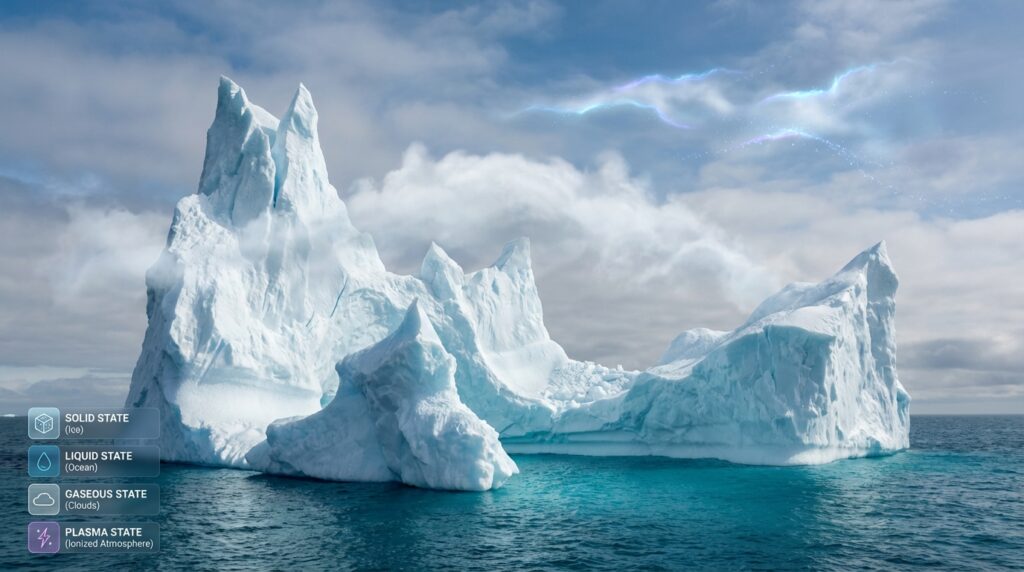
• Earth (prithvi) represents the quality of solidity (solid ice).
• Water (ap) signifies liquidity (liquid water) and relative motion.
• Air (vāyu) represents the quality of expansion (gas, water vapour, or clouds).
• Fire (agni) represents heat or energy, which manifests in high-energy states such as plasma (the ionosphere).
The process by which Prana coalesces into these forms is likened to sugarcane juice condensing into treacle or solid sugar candy; the underlying essence remains identical even as it assumes a dense, tangible form.
This manifestation is driven by Spanda, the primordial pulsation or vibration of Consciousness that allows the One to appear as the multiplicity of the universe.
Just as whirlpools in a river are merely temporary modulations of the one undivided flow of water, all physical states—from solid ice to water vapour—are temporary modulations of Universal Consciousness.
From a scientific perspective, this ancient framework aligns with quantum field theory, which posits that particles and matter emerge as vibrational modes and quantized excitations of underlying universal fields.
The ionosphere and high-energy phenomena are seen as the radiant vibration of the Great Light of Consciousness, made manifest through its sovereign power of action.
Ultimately, these basic states of Form are abhasas (manifestations) that appear within the “mirror of Consciousness,” which projects its own nature onto itself to experience its infinite creative potential.
How does the sound of OM relate to these elements
The sound of OM (or AUM) is regarded as the root syllable and the universal cosmic vibration that holds together the atoms of the world and the heavens.
It is the most sacred of all sounds, acting as the “best of all essences” from which matter itself proceeded.
In the yogic and Tantric traditions, the three syllables of AUM correspond to specific levels of reality that parallel the elements: “A” represents the Gross realm and the waking state; “U” represents the Subtle realm and the dreaming state; and “M” represents the Causal realm and the state of deep sleep.
The relationship between OM and the elements is further defined through the following concepts:
• Source of Manifestation: All elements—Prana-Ether, Air, Fire, Water, and Earth—are said to have emerged from the Bindu, a trans-dimensional point of absolute potentiality that is the substratum of the cosmos and the source of the sound of OM.
• The Three Matras: The three and a half coils of the Kundalini serpent represent the three matras (A, U, and M), which relate to the physical world and the elements, while the remaining half-coil signifies the state of transcendence beyond the manifest universe.
• The Ajna Chakra: OM is the bija mantra for the Ajna chakra (the third eye), which is the command center that integrates all sensory perceptions and controls the functions of life. It is at this center that the vital and mental forces (nadis) merge into a single stream of consciousness.
• Pervasive Vibration: In its highest form (Para-vac), OM is the “totality of sound” where the vibration and the objects it names—such as the physical elements—are undivided and indivisible.
• Elemental Correspondences: Ancient texts symbolically align the threefold nature of OM with various trinities, including Elemental Deities such as Fire (Agni), Sun (Aditya), and Wind (Vayu).
Ultimately, the soundless silence that follows the utterance of OM corresponds to the Fourth State (Turiya) [which strictly speaking is not a state], the pure Consciousness that permeates and sustains all the elements and states of matter.
This “one song” or universal vibration ensures that even as Prana coalesces into different forms like solid ice or plasma, it remains identical to the Supreme Reality symbolized by OM.
Breathing is the Link
The four penultimate elements are breathed in the same way that the the human form breathes air.
Air is outside the human form; it is breathed into the form; it circulates through the passageways of the form; the energy is absorbed and the waste is expelled.
Water is consumed from a source outside the form; it flows through the passageways of the form; its energy is extracted and the waste is expelled;
Food is consumed from a source outside the form; it flows through the passageways of the form; its energy is extracted and the waste is expelled.
Vitamin D is absorbed from a source outside the form; it passes through the passageways of the form; its energy is absorbed and the waste is expelled as heat, light and passion.
Breathing
The human form functions as a metabolic system of reciprocity, where the Ultimate Element, Prana, and the Four Penultimate Elements are continuously processed through cycles of absorption, circulation, and expulsion.
This “breathing” of the elements ensures that the individual remains a temporary modulation of Universal Consciousness, inextricably coupled with the environment through thermodynamic and energetic exchanges.
This elemental processing manifests through specific chakras and physiological channels (nadis):
• Air (Vayu): The form “breathes” air through a conical pathway merging at the eyebrow centre (Ajna) and descending to the lungs. During this cycle, Prana (the upward energy) and Apana (the downward energy) move between the navel and the throat, where the body extracts vital force before expelling waste gases.
• Water (Apa): Consumed from external sources, water flows through the “passageways” of the reproductive and urinary systems, which are governed by the Swadhisthana chakra. The form extracts the liquid’s energetic essence—often associated with the Subtle realm—and expels physical and energetic waste to maintain internal balance.
• Earth (Prithvi/Food): Food constitutes the Annamaya Kosha (the body of nourishment). It is ingested and processed at the Manipura chakra (the solar plexus), where the digestive fire (Agni) extracts energy and Samana Vayu discriminates between useful nutrients and waste. The physical residue is then expelled via the Mooladhara chakra (the excretory system).
• Fire/Light (Agni/Teja): The form absorbs solar energy—symbolically represented by Vitamin D or the “Great Light”—through the skin and eyes. This “fire” passes through the form to regulate internal temperature and metabolic “yogic fire”. The body utilizes this luminosity for Self-awareness and vitality, eventually expelling excess energy as heat and light radiation, mirroring the “fire” that consumes the “forest of duality”.
Ultimately, these elements are leaky and porous, meaning they are constantly in a state of becoming through ingestion and discharge.
The human body is like a whirlpool in the infinite ocean of life, where fresh quantities of Prana enter to replace the old, ensuring the “One Song” of the universe remains constant even as its constituent forms appear to change.
Through Pranayama (breath control) and the purification of the tattwas, an individual can refine this “breathing” process, transforming the expulsion of waste into a means of attaining supreme illumination.
Leave a Reply