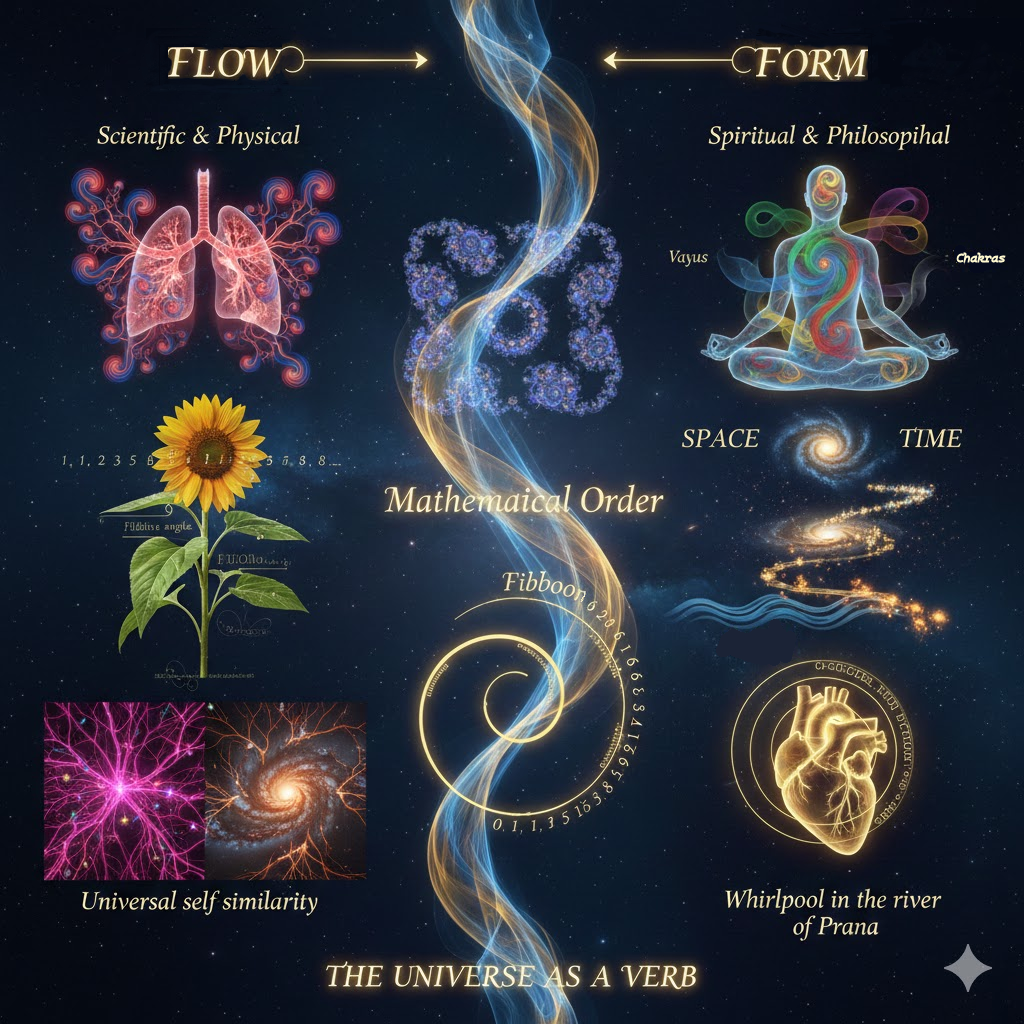
Across scientific, mathematical, and spiritual domains, the relationship between “Form” and “Flow” is a dynamic interplay where structure is an emergent property of movement. Rather than static objects existing in space and time form is a temporary manifestation of an underlying, continuous flow.
1. Form as Emergent Flow (Scientific & Physical)
In physical systems, intricate forms emerge directly from the dynamics of flow:
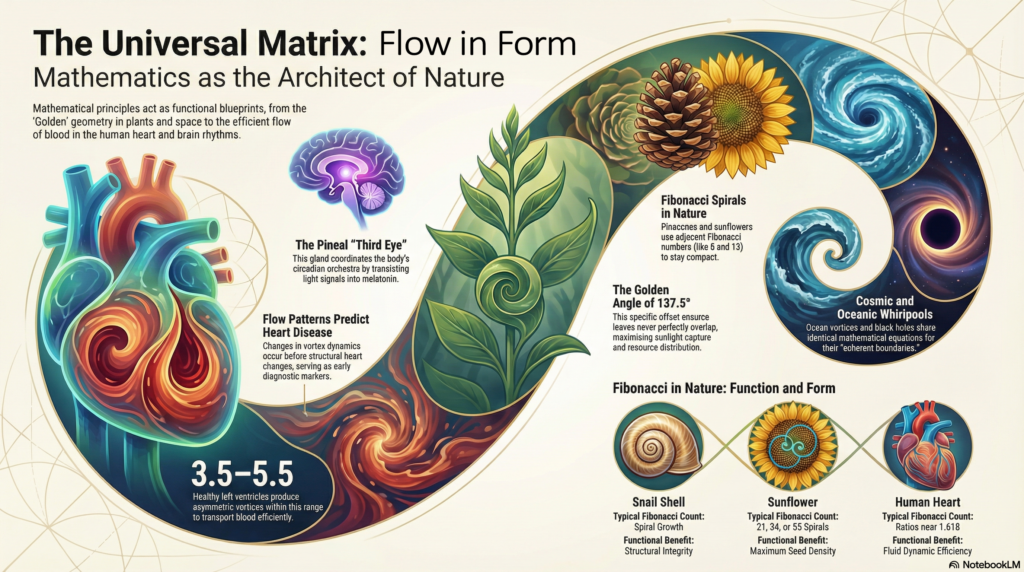
- Aerodynamics of the Lungs: The “asymmetric geometry” of the human lung significantly influences the development of pulsatile flow fields, creating secondary vortex structures during respiration.
- Biological Growth: The spiral forms seen in nature—such as the 137.5° golden angle in plants—emerge from a simple “local rule” where new growth (primordia) positions itself in the largest available gap.
- Universal Self-Similarity: Structural parameters reveal “unexpected agreement levels” between the neuronal network of the brain and the cosmic web of galaxies, suggesting both complex networks evolve following similar physical principles.
2. Mathematical Order (Fractals & Fibonacci)
Mathematics provides the “alphabet” or “script” that describes how flow organizes into form:
- Fractal Geometry: Fractals are described as “self-similar patterns” that make visible how structure is brought into space and events are brought into time. They act as a “strategy of the natural order” to shape mountains, meandering rivers, and trees through “rewriting repetition”.
- The Fibonacci Sequence: This mathematical sequence (0, 1, 1, 2, 3, 5, 8…) acts as “nature’s little secret,” appearing in the arrangements of flower petals, pinecones, and even the arms of spiral galaxies.
3. Spiritual & Philosophical Perspectives
In spiritual traditions, the distinction between form and flow is often viewed as an illusion of the mind:
- Prana as Reality: Reality is described as a “unified, continuous flow of energy known as Prana,” rather than a collection of static objects.
- Space and Time as Verbs: Space and time are not “containers” for reality but “active manifestations” or “verbs” of this singular flow. “Feeling” manifests as spatial extension, and “thought” creates the narrative of time.
- The Microcosm: The human body is a “localized expression of the universal current,” where the heartbeat is not a mechanical pump but a “whirlpool in the river of Prana”.
- Identity as Flow: Shifting perspective involves seeing oneself as a “dynamic, timeless ‘verb’ unfolding in the present moment” rather than a fixed entity. Practices like tuning into the Vayus (winds of Prana) or conscious breathing serve as the “bridge” to interact with this flow.
Leave a Reply