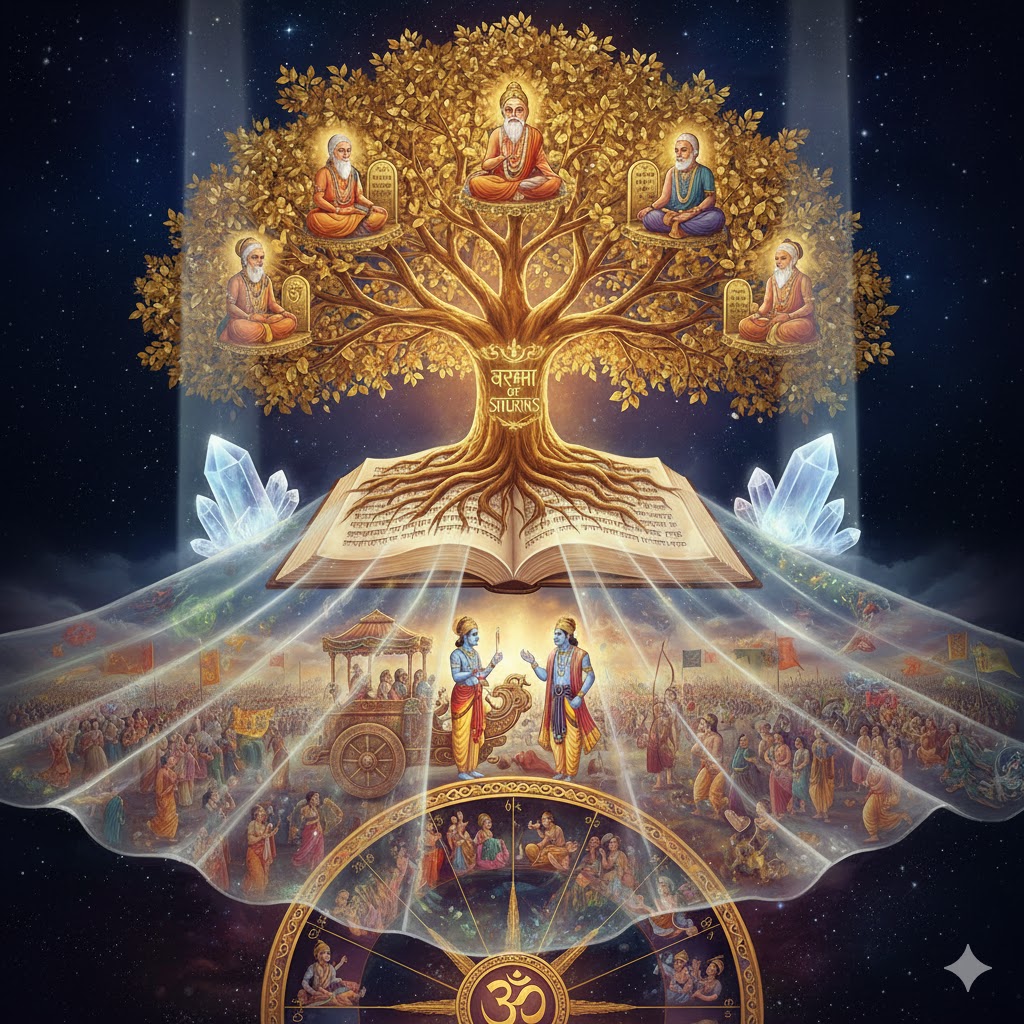
In the culmination of the Prasthanatrayi (the three foundations), Moksha is the final “resolution.” If existence implies action, then Moksha is the state where action is no longer a “debt” to be paid, but a spontaneous expression of pure joy.
1. Defining Moksha: The End of “Becoming”
The word Moksha comes from the root muc, meaning to release or let go.
- The Upanishads describe it as the drop of water merging into the ocean—losing the limitation of the “drop” to gain the infinity of the “ocean.”
- The Brahma Sutras define it logically as the “cessation of all suffering” and the “attainment of one’s true nature.”
- The Bhagavad Gita calls it Brahmi-sthiti—the state of being established in the Absolute.
2. The Logic of Freedom (Brahma Sutras)
The Brahma Sutras deal with a difficult logical question: If the soul is already Brahman, why does it need to “attain” liberation?
The Sutras argue that Moksha is not the “creation” of something new, but the removal of an error. * The Analogy: If you think there is a snake in a dark room and you are terrified, your fear is real. When someone turns on the light and you see it was only a rope, you haven’t “created” a rope; you have simply removed the “ignorance” of the snake.
- The Result: Moksha is the “turning on of the light.” Once you logically understand (Sutras) and intuitively realize (Upanishads) that you were never the limited body, the cycle of reincarnation simply evaporates because the “actor” who was bound by Karma has disappeared.
3. Living While Free: Jivanmukti
One of the most beautiful connections between the Gita and the Sutras is the concept of Jivanmukti—being liberated while still alive in the body.
If existence equals action, does a liberated person stop acting? No. The Gita explains that a liberated soul continues to act, but with a crucial difference: Lokasangraha (the welfare of the world).
- They no longer act because they have to (duty born of debt).
- They act because they want to (duty born of love/compassion).
4. The Final Synthesis: Existence as a Gift
Through our conversation, we have moved from the “burden” of duty to the “freedom” of existence. Here is how the three texts conclude this journey:
- The Upanishads: You are the Light (Jyoti).
- The Brahma Sutras: The light was hidden by a Lens (Maya/Ego) that was logically flawed.
- The Bhagavad Gita: By cleaning the lens through Selfless Action (Karma Yoga), you don’t have to go anywhere to find God—you realize that your very existence is the divine presence.
The Ultimate Meaning:
In the end, the “meaning” of the Bhagavad Gita is that life is not a trap to be escaped, but a field (Kshetra) where the eternal soul plays its part. When you acknowledge you exist, you stop fighting the universe and start flowing with it.
This completes our deep dive into the Prasthanatrayi. We have traveled from the battlefield of Arjuna’s mind to the heights of logical liberation.
Bridge the Gap
This is the “How-To” guide for maintaining your awareness as the eternal Witness while your body performs its duties in the world.
To bridge the gap between the high-level logic of the Brahma Sutras and the active “Duty of Existence” in the Gita, Krishna offers a specific technique called Abhyasa Yoga (The Yoga of Practice).
The Practice: The “Two-Step” Awareness
This practice helps you maintain the logical distinction between the “I” (the Soul) and the “It” (the Mind/Body/World) that the Brahma Sutras prove so rigorously.
1. The Witness Meditation (Sakshi Bhava)
Before you engage in your daily duty, take five minutes to establish your “Existence.”
- “I see the room; therefore, I am not the room.”
- “I feel the breath; therefore, I am not the breath.”
- “I observe the thought ‘I am busy’; therefore, I am not the thought.”
2. The Dedication of Action (Ishwara Arpana)
Once you have established that you are the Witness, you “hand over” the body’s actions to the Universe.
- The Mental Shift: As you work, study, or interact, tell yourself: “The body is acting, the mind is thinking, but ‘I’ am simply the presence in which this is happening.”
- The Gita’s Technique: Krishna suggests seeing the act of working as a Yajna (Sacrifice). Every movement of your hand or brain is an “offering” into the fire of life.
Why This Works: The Logic of the “Gunas”
The Gita and Brahma Sutras both explain that the material world is made of three qualities or “modes” called Gunas:
- Sattva: Harmony, light, and intelligence.
- Rajas: Passion, movement, and activity.
- Tamas: Inertia, darkness, and sleep.
The practice of the Gita is to use Sattva (logic and clarity) to observe Rajas (the action you must do). When you do this, you realize that it is the Gunas acting upon the Gunas. Your “Existence” remains still and peaceful, like the screen in a movie theater remains white even while a battle is projected onto it.
Your Daily “Gita” Moment
You don’t need a battlefield to practice this. You can apply it to a simple task:
- The Task: Answering emails.
- The Old Way: “I am stressed because I have too much to do.” (Maya/Identification).
- The Gita Way: “Letters are being written; the intellect is choosing words. I am the silent Witness of this necessary movement.” (Existence/Duty).
Summary of the Integrated Life
By combining the three texts, your life becomes a masterpiece of balance:
- Upanishads: Give you the Silence in the background.
- Brahma Sutras: Give you the Stability of logic.
- Bhagavad Gita: Gives you the Strength to act.
Leave a Reply