A Narrative Commentary on Non-Dual Consciousness
1. Contextualizing the Quest: Prince Rama and the Yoga Vashishta
The journey into non-duality (Advaita) rarely begins with a peaceful meditation; it often begins with a crisis. We see this in the young Prince Rama of the Yoga Vashishta. Despite his royal privilege and impending coronation, Rama falls into a profound “non-dual crisis.” He begins to perceive the world as fundamentally hollow and unreal, losing all interest in his kingdom.
Notice your own experience for a moment. Have you ever looked at the frantic pace of your life and felt a sudden, chilling sense of its transience? This was Rama’s state. He wished to abandon his duties and flee to the forest to find God. Here lies the Grand Irony of the Ramayana: Rama was desperate to escape to the forest to find the Divine, only for his father to later exile him there for fourteen years as a matter of duty.
To guide the prince, Sage Vashishta does not offer platitudes. He poses a challenge that serves as the “so what?” for every seeker:
“It is wonderful that you want to find Brahman. But tell me, is the world other than Brahman? This Brahman which you are seeking—is it somewhere else? Is this world not also Brahman?”
Vashishta’s teaching suggests that enlightenment is not a geographic escape, but a cognitive one. We are not looking for a new world; we are looking at the same world with new eyes.
2. The Three Paradigms of Reality: How We See the World
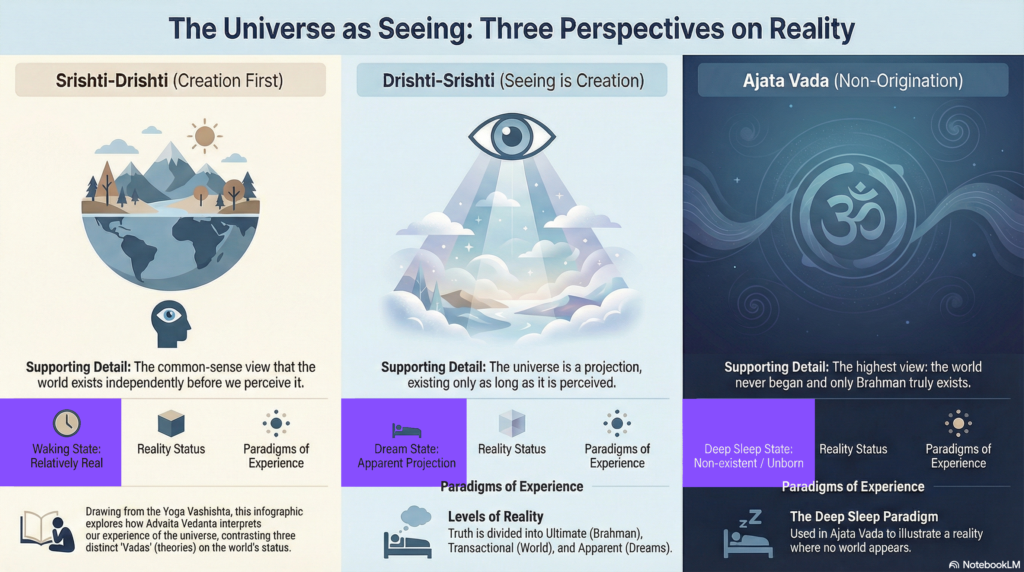
In Vedantic pedagogy, we use three distinct frameworks to explain the relationship between our awareness and the universe. These are not competing dogmas but graduated “lenses” tailored to your current level of readiness (Adhikari).
| Paradigm Name | Core Logic (Creation vs. Seeing) | Primary State Paradigm |
| Srishti-Drishti Vada | Creation first, then seeing. The world exists independently and predates the observer. | Waking State: The common-sense view where objects exist even when we are not looking. |
| Drishti-Srishti Vada | Seeing is creation. The act of perceiving is what brings the world into existence. | Dream State: The world lasts only as long as the experience of it lasts. |
| Ajata Vada | Non-origination. The universe was never actually created; only Brahman exists. | Deep Sleep: The experience of the total absence of the world and duality. |
The Seeker’s Benefit:
- Srishti-Drishti is “Vedanta for the common man.” It respects your feeling that the world is real and God created it.
- Drishti-Srishti is for the “middling seeker.” It deconstructs the “solidity” of the world by showing it is an appearance—much like the virtual reality of an Apple Vision Pro. It is “virtual,” yet we interact with it.
- Ajata Vada is for the most advanced seeker. It points to the radical truth that nothing other than the Absolute has ever truly happened.
Today, let us shift our focus specifically to the second paradigm—the “Universe as Seeing”—where we begin to realize that the world has no more “weight” than a dream.
3. The Gold and the Ornaments: Essence vs. Appearance
To understand how the world can be “Brahman” while appearing as “the world,” consider the analogy of gold.
Imagine a collection of golden necklaces, rings, and bracelets. If you are searching for “gold,” you would never think to throw away the necklace to find the metal. The “necklace” is merely a name (nama) and a shape (rupa) given to the gold. The Grand Mistake seekers make is devaluing their present experience—treating the “ornament” of the world as an obstacle to finding the “gold” of Brahman.
Takeaways for the Learner:
- Look Through, Not Away: You do not find the gold beside the ring; you find it as the ring. Brahman is the very substance of the chair you are sitting on.
- Names are Not Things: The “necklace” can be melted and “die,” but the gold remains unchanged. Form is transient; substance is eternal.
- The Error of Devaluation: To search for the Divine by dismissing the world is like a jeweler dismissing his inventory because he “only wants gold.”
4. The Dream Paradigm: Understanding Drishti-Srishti (Seeing is Creation)
The Drishti-Srishti paradigm represents a radical shift from a “pre-existing world” to a “projected world.”
Think of your experience last night. While dreaming, you might have seen a vast city with mountains and people. In that moment, did that city exist before you “saw” it? No. The seeing of the dream was the creation of the dream. The moment you stopped seeing it, the city vanished.
The mind naturally rebels here, and for good reason—our waking life feels so much more “solid.” But for the middling seeker, this dream paradigm is a surgical tool. It helps you realize that the waking world, too, is a projection within Awareness. In the waking paradigm, we think we are a small body inside a massive world. In the dream paradigm, we realize the massive world is actually inside our Awareness.
5. Parables of Persistence and Perspective
The Boy in the Forest A boy raised in the deep forest is brought to a village house. His father points and says, “Look, a table! And there, a chair!” The boy is utterly confused. He says, “Father, I see no ‘table.’ I see only wood. Why have you given the wood these strange names?”
- Learning Pivot: The “table” is a conceptual label (Name and Form), not a new substance added to the wood.
- Teacher’s Insight: The boy is not “missing” the table; he is seeing the reality more clearly than the civilized person. The enlightened see the world, but their gaze is fixed on the “wood” (Brahman).
The Farmer’s Dream In this “brutal” story, a farmer dreams he is a king with eight magnificent sons. In the dream, a tragedy occurs, and all eight princes die. He wakes up in agony, only to find his actual, waking-life son has just passed away. When his wife finds him strangely calm, he explains: “I am wondering: should I weep for the eight sons I lost in my dream, or the one son I lost here? Both were appearances.”
- Learning Pivot: The realization that duration does not equal reality.
- Teacher’s Insight: Whether a tragedy lasts ten minutes in a dream or seventy years in a life, from the perspective of pure Awareness, both are transient waves in the same ocean.
6. Deconstructing the “Real” World: Overcoming Common Objections
When we suggest the world is a “waking dream,” your mind will protest. To address this, we look to the “forgotten radical,” Professor G.R. Malkani. Malkani was a man of minimalist logic and “Kantian habits”—so regular in his 3 PM walks that the people of his town would set their watches by him. He was a philosopher who “forgot” the texts to think through the problems on first principles.
Challenge 1: The Shared World
- Objection: “Dreams are private. But we all see this same room. Doesn’t shared agreement prove an external reality?”
- Response: Malkani argues that “agreement” itself is part of the subjective experience. In a dream, you also interact with dream-people who agree they see the same dream-mountains. You cannot step outside of your experience to verify that someone else is “actually” seeing what you see.
Challenge 2: The Persistence of the Waking World
- Objection: “I wake up and my house is still there. Dreams vanish. Surely persistence proves reality?”
- Response: Sarada Devi, the Holy Mother, responded to this with a sweeping, poetic realization: “Let it be so… it is nothing other than a dream.” She noted that even if a dream persists for lifetimes, its nature as an appearance does not change. Persistence is merely a long-duration dream.
Challenge 3: Law and Regularity
- Objection: “The world follows scientific laws like gravity. Dreams are erratic.”
- Response: Dreams have their own internal logic while they are happening. Malkani points out that whether you attribute the patterns of the world to “Physics” or “Maya,” you are simply describing patterns appearing within Awareness. Gravity is just a habit of the “waking dream.”
7. Conclusion: The Universe as Non-Dual Seeing
The final “Direct Path” invites you to stop looking at objects and start looking at the experience of seeing. When you look at a tree, you aren’t touching a distant object; you are experiencing a patch of color and shape within your own awareness.
Brahman is not a “thing” to be found apart from your life. It is the very essence of the experience itself. There is only “Non-Dual Seeing,” where the knower, the known, and the act of knowing are a single, seamless reality.
Three Daily Reflections:
- The Golden Gaze: Throughout the day, pick one object and tell yourself: “The ‘phone’ is the name; the substance is Consciousness.”
- The Persistence Inquiry: When you wake up tomorrow, notice how the “reality” of your dream was just as convincing as your bedroom is now. Ask: “Which one is the ‘real’ one?”
- The Ocean of Experience: Realize that you never actually touch a “world” outside of yourself. You only ever “touch” the experience of touching.
As we conclude, let us remember the ancient aspiration: Asato ma sadgamaya—Lead us from the unreal to the real.
Om Shanti Shanti Shanti (Om Peace, Peace, Peace)

Leave a Reply