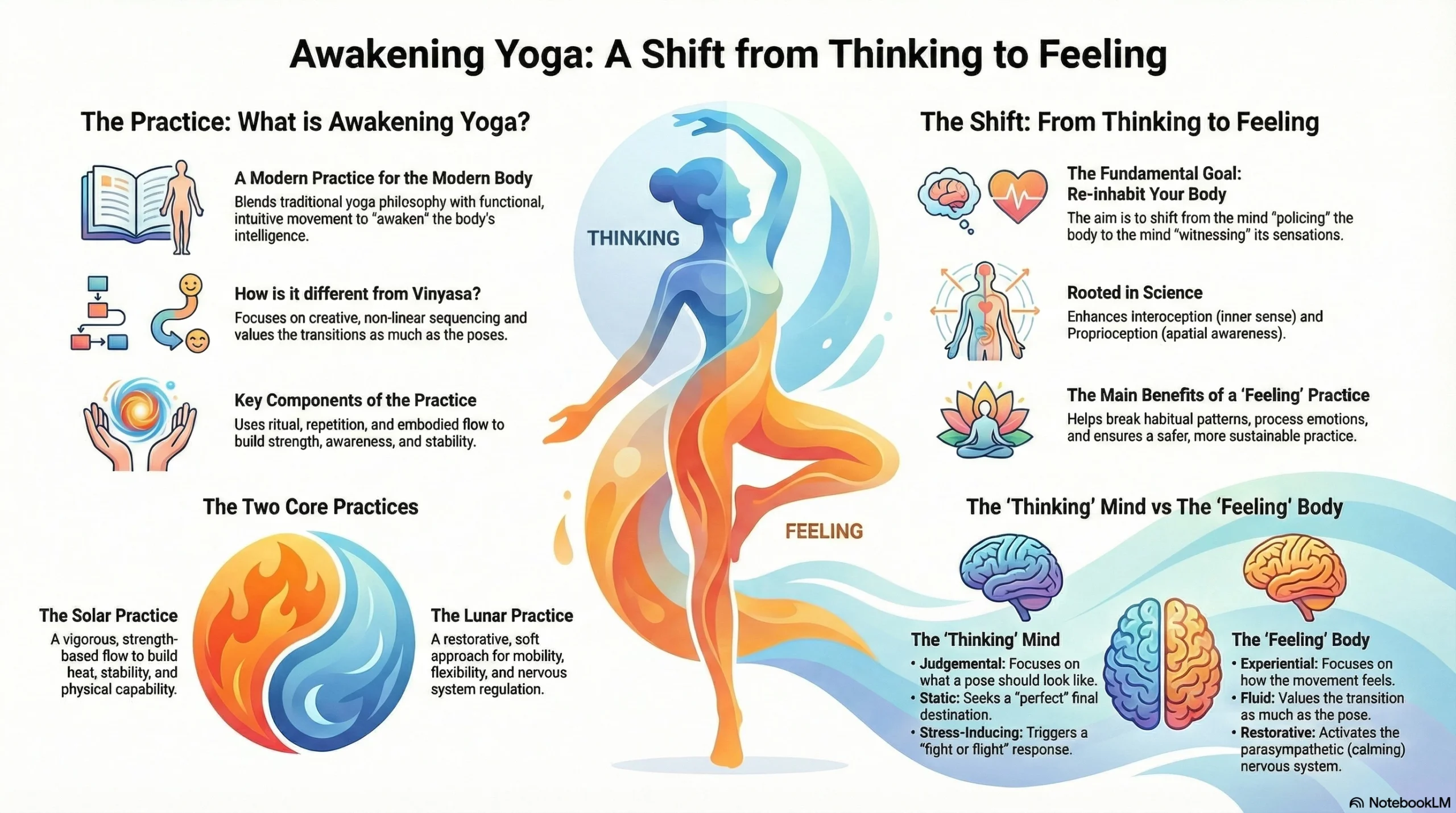
Awakening Yoga is a progressive yoga system designed to bridge the gap between traditional yoga philosophy and the needs of the modern human body. Rather than adhering strictly to rigid, linear shapes, Awakening Yoga focuses on functional movement, freedom of expression, and intuitive sequencing. It is a practice designed to “awaken” the body’s natural intelligence and adaptability.
Core Pillars of the Practice
The system is built on specific foundations that prioritize the practitioner’s internal experience over external perfection:
- Functional Movement: Prioritizes how the body naturally moves in daily life over how a pose “should” look based on historical aesthetics.
- The Solar Practice: A vigorous, strength-based practice focused on building heat, stability, and physical capability.
- The Lunar Practice: A restorative, soft, and introspective approach focused on mobility, flexibility, and nervous system regulation.
- Freedom of Movement: Encourages practitioners to explore “the space between the poses,” moving organically rather than snapping from one static shape to another.
Awakening Yoga vs. Traditional Vinyasa
While both styles use breath-to-movement synchronization, there are key differences in their approach to the body and mind:
| Feature | Traditional Vinyasa | Awakening Yoga |
| Sequencing | Often follows a set linear path (e.g., Sun Salutations A/B). | Creative, non-linear, and often circular patterns. |
| Alignment | Strict adherence to “classic” geometric shapes. | Focused on individual anatomy and joint safety. |
| Transition | Transitions are often a means to an end. | Transitions are considered as important as the poses. |
| Primary Goal | Mastery of specific asanas (poses). | Mastery of body awareness and functional strength. |
Key Components of the Practice
1. Ritual and Repetition
Classes often start with familiar movement patterns to “wake up” the nervous system. This repetition allows the mind to quiet down so the practitioner can move away from cognitive overthinking and into felt sensation.
2. Handstand and Inversion Prep
A signature element of this style is its accessibility toward inversions. By emphasizing weight-bearing in the hands early on, the practice builds the shoulder stability and core integration necessary for advanced movements in a safe, incremental way.
3. Embodied Flow
Movement is never truly static. Even in a held pose, there is an invitation to micro-move, pulse, or shift weight to find a “sweet spot” that feels therapeutic for the individual’s unique bone structure and muscle tension.
In Awakening Yoga, the transition from thinking to feeling is not just a stylistic choice; it is the fundamental mechanism for transformation. While traditional yoga often asks the mind to “police” the body (checking for perfect alignment or the “correct” shape), Awakening Yoga invites the mind to become a witness to the body’s internal sensations.
The Science of “Feeling” the Practice
This shift is rooted in two biological processes that Awakening Yoga seeks to optimize:
- Interoception: This is your “inner sense.” It is the ability to feel what is happening inside your body—your heartbeat, the depth of your breath, or the subtle release of a muscle. Developing interoception creates a stronger sense of self and emotional resilience.
- Proprioception: This is your body’s ability to perceive its position in space. By moving away from “thinking” about where your foot should go and instead “feeling” your weight distribution, you build a more intelligent, adaptable physical foundation.
Why the Shift Matters
| The “Thinking” Mind | The “Feeling” Body |
| Judgmental: Focuses on what a pose should look like. | Experiential: Focuses on how the movement actually feels. |
| Static: Seeks a “perfect” final destination. | Fluid: Values the transition as much as the pose. |
| Stress-Inducing: Often triggers the “fight or flight” response through self-critique. | Restorative: Activates the parasympathetic nervous system through presence. |
| Disconnected: Operates from the head down. | Integrated: Operates from the center out. |
Key Benefits of Moving into “Feeling”
- Breaking Habitual Patterns: We often move on autopilot. By “feeling” into a movement, you notice the micro-tensions and compensations your body makes, allowing you to unravel chronic holding patterns.
- Emotional Processing: Somatic philosophy suggests that stress and trauma are stored in the body’s tissues. Moving with “feeling” allows these trapped energies to be identified and released through the physical vehicle.
- Safety and Sustainability: When you think, you might push into a pose that causes pain because you want to “master” it. When you feel, you intuitively know when to back off, ensuring your practice remains sustainable for a lifetime.
How to Practice the Shift
- Close Your Eyes: Removing visual distraction immediately heightens your internal sensory feedback.
- Slow Down: Movement at a “honey-like” pace forces the nervous system to stay present with every millimeter of the transition.
- Ditch the Mirror: Rely on your internal “map” rather than external validation.
- Embrace Novelty: Move in non-linear or circular patterns that the brain hasn’t memorized, forcing you to “feel” your way through the space.
What This Means
Moving from thinking to feeling in Awakening Yoga is an act of re-inhabiting your body. It shifts the goal from “performing” yoga to “experiencing” yoga. This embodiment fosters a deeper dialogue between the mind and body, leading to a state of neutral potentiality where true growth and healing can occur.
Key Takeaways:
- Interoception is the key to emotional intelligence and self-regulation.
- Feeling prevents injury by respecting biological boundaries over mental ego.
- The Transition is where the “awakening” actually happens.
- Modern Alignment: It updates traditional Hatha Yoga for 21st-century bodies (counteracting the effects of prolonged sitting).
- Strength + Fluidity: It balances the “Yang” of muscular strength with the “Yin” of fluid, intuitive motion.
- Neuro-Centric: Uses repetitive movement to soothe the nervous system while challenging the brain with non-linear patterns.
People Also Ask Regarding: Awakening Yoga
Is Awakening Yoga for beginners?
Yes. Because the system focuses on functional movement rather than “achieving” a specific shape, it is highly adaptable. Modifications are encouraged to suit different fitness levels.
Do I need to be able to do a handstand?
No. While the practice includes “drills” that lead toward inversions, the goal is to build the strength and confidence required to support your own weight, regardless of whether you ever kick up.
What is the difference between Solar and Lunar classes?
Solar classes are active, sweaty, and focused on building power. Lunar classes are cooling, slow, and focused on deep stretching and relaxation.
Summary: Awakening Yoga
Awakening Yoga is a comprehensive movement system that respects yoga’s roots while embracing modern kinesiology. By focusing on functional strength, creative sequencing, and the balance between effort (Solar) and ease (Lunar), it empowers practitioners to develop a sustainable, lifelong practice that supports both physical health and mental clarity.
A ‘Moving’ Meditation

To complement the fluid, non-linear nature of Awakening Yoga, a Circular Joint Awakening meditation is an ideal moving practice. This meditation focuses on the “space between the poses” and helps transition the mind from a state of thinking to a state of feeling.
The Circular Joint Awakening Meditation
This 5–10 minute practice is designed to be performed at a slow, honey-like pace. Instead of focusing on a destination, you focus on the continuous loop of motion.
Step-by-Step Instructions
- Find Your Base: Stand with your feet slightly wider than hip-distance apart, knees soft and bouncy. Rest your hands lightly on your thighs or let them hang at your sides.
- The Ripple (Spine): Close your eyes. Begin to make small, circular motions with your nose, as if drawing a spiral in the air. Let this circle grow until your neck, shoulders, and eventually your entire ribcage are undulating in a rhythmic, circular pattern.
- The Joint “Oil”: Imagine your joints (wrists, elbows, shoulders, hips) are filled with warm oil. Begin to rotate each joint one by one. Do not worry about “correct” form—simply find the most fluid path for each limb.
- Weight Shifting: Slowly shift your weight from the balls of your feet to your heels, and from the left edge to the right edge. Feel the ground beneath you as an active participant in your movement.
- Breath Integration: Inhale as you expand or lift your chest; exhale as you contract or round your back. Let the breath be the “wind” that pushes your body into the next movement.
Why This Fits Awakening Yoga
| Feature | Moving Meditation Benefit |
| Neuroplasticity | Non-linear movements challenge the brain to map the body more accurately. |
| Fascial Release | Slow, multi-directional movement hydrates the connective tissue (fascia). |
| Anxiety Reduction | Rhythmic, repetitive swaying triggers the parasympathetic nervous system. |
Key Meditation Takeaways
- No “Right” Way: If it feels good, you are doing it correctly.
- Eyes Closed: Turning your gaze inward (Pratyahara) enhances the “Awakening” of internal sensations.
- Consistency: Just 5 minutes of this can reset your nervous system after a long day of static sitting.
Pro Tip: Try practicing this meditation to ambient, beat-less music. This prevents your body from trying to “keep time” and allows you to move at the speed of your own breath.
Meditation Summary:
This moving meditation acts as the bridge between the Solar (strength) and Lunar (restoration) aspects of Awakening Yoga, teaching the body to remain fluid even when it is not in a formal “pose.”
Application in a Traditional Pose
In Awakening Yoga, the transition from Thinking to Feeling is often best explored through “Feeling-Based Cues.” Instead of focusing on external geometry, these cues target your internal sensory systems: Proprioception (your body’s position in space) and Interoception (your internal physiological state).
Below is a guide to re-inhabiting your body through one of yoga’s most common poses.
Awakening Your Senses: Feeling-Based Downward Facing Dog
In this version of the pose, we discard the “perfect triangle” and instead look for a “functional exploration.”
1. The Hands: Proprioceptive Anchoring
- Thinking Cue: “Place your hands shoulder-width apart.”
- Feeling Cue: “Press your palms into the mat and imagine you are trying to tear the mat in half between your hands. Feel how that tension travels up your arms and stabilizes your shoulders.”
2. The Spine: Interoceptive Length
- Thinking Cue: “Keep your back straight.”
- Feeling Cue: “Close your eyes. As you inhale, feel the breath expanding the back of your ribs. As you exhale, imagine your tailbone is a helium balloon floating toward the ceiling, creating space between every vertebra.”
3. The Legs: Organic Movement
- Thinking Cue: “Press your heels into the floor.”
- Feeling Cue: “Pedal your feet slowly. Don’t just move the ankles—feel the stretch ripple through the calf, into the hamstrings, and all the way to your lower back. Move like you are walking through warm honey”
Leave a Reply