Why You Are a Happening, Not a History
1. The Heavy Weight of Boundaries
We often carry the heavy weight of our own boundaries, feeling like a solitary island in a vast, indifferent sea. This sense of being a completely separate, isolated individual is perhaps the most common human experience, yet it is a perspective that obscures a more profound reality.
Spiritual Awakening is not the acquisition of new, book-learned knowledge or some esoteric secret.
Instead, it is the realization that you are simultaneously Fully Human and Fully Spiritual. It is your everyday experience “seen correctly,” which is why it is called an awakening rather than an achievement.
By shifting our perspective, we begin to see our lives not as static objects, but as intrinsic parts of a singular, living whole.
2. You Are a Verb, Not a Noun
What you are and how you appear are not-two things.
In our modern world, we are conditioned to view ourselves as “nouns”—fixed, static objects.
But nondual wisdom suggests we are more like “verbs”: constant, dynamic processes or “happenings.”
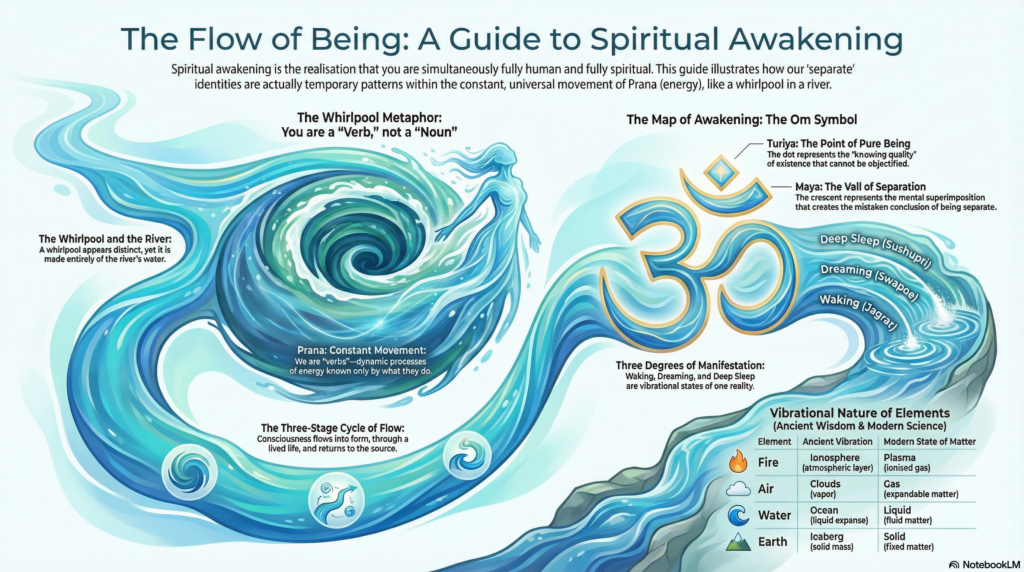
Look closely at the metaphor of a whirlpool in a river.
You can point to a whirlpool and see its distinct shape and boundaries. It appears to be a separate thing, yet it is made entirely of the river.
There is no point where the river ends and the whirlpool begins. The form exists only because of the flow.
You can feel this “verb-ness” in your own body right now.
Your breath is a flow of air; your blood is a literal river in constant movement.
You are not a container for life; you are the process of living itself.
“The whirlpool is not a thing in the river; it is the river itself, acting ‘whirlpool-wise’ for a brief moment in time.”
3. The Myth of the Separate “Feeler”
Our minds create a “myth of separation” through the process of super-imposition. Consider a simple sensory experiment: the act of smelling a rose.
If you close your eyes and focus entirely on the scent, there is only “smelling.”
There is no “me” and no “rose”—just the experience.
It is only when you open your eyes and see the rose as a separate object that the mind super-imposes the idea of a separate “nose” or a separate “feeler.”
This logical proof reveals that the idea of a separate form sensing via a “sense door” is a label added after the fact.
In the Mandukya Upanishad, this is represented by the crescent in the Om symbol, called Maya.
Maya is the veiling power of super-imposition, the mental activity that solidifies the mistaken conclusion that the observer is separate from the observed.
“The Observer is the Observed.”
4. Ancient “Prana” is Modern “Energy”
The ancient and modern converge at the point of “Constant Movement.”
The Sanskrit term Prana translates literally to this movement, aligning with Albert Einstein’s E=mc^2.
As Einstein would admit, scientists do not actually know what energy is in its essence; they only understand it via what it does—its effects and transformations.
To understand how this “Energy-in-Formation” becomes the world, look at an acorn. The DNA in the acorn acts as information that orders the elemental energies of Fire (sunlight), Air (gases), Water (rain), and Earth (soil) to materialize as an oak tree.
Form is simply energy acting in a specific way.
Both the sage and the physicist conclude that there is an intangible reality powering both the stars and your own heartbeat.
“Prana is what scientists call energy. We do not know what Energy is; we understand it via what it does.”
5. Individuality is Just “Debris in the Stream”
If we are all expressions of the same “river,” why do we appear so vastly different? This can be understood through the “twigs and leaves” caught in a whirlpool’s spin.
Just as one whirlpool might collect a specific branch or handful of leaves that give it a unique visible pattern, each human being carries a unique collection of memories, quirks, and genetic traits.
These elements create difference, but they do not create distance. A whirlpool with a twig is distinct from one without, but both are one hundred percent river.
This perspective allows you to cherish your unique human personality without the exhausting delusion of being disconnected from the Source.
6. The “Four States” and the Truth of “Am”
The Mandukya Upanishad—named for the Mandukya or “frog” because it facilitates a jump in consciousness—uses the Om symbol to map our reality across different levels of density:
- Jagrat (Waking Consciousness): The “Gross Level.” This is the waker and the waker’s world of physical bodies in space and time.
- Swapna (Dream Consciousness): The “Subtle Level.” Here, form is purely mental—a dreamer and a dreamer’s world.
- Sushupti (Deep Sleep): The “Causal Level.” Though experienced as a blankness, it contains the “seeds” of your manifestation and memory.
- Turiya (The Dot): Known as “The Fourth,” it is paradoxically also “The First.” It is represented by the dot at the top of the Om symbol.
Crucially, Turiya is not “I am” (the person), but simply “Am”—the pure, knowing quality that you exist.
This quality remains constant whether you are awake, dreaming, or in deep sleep.
Awakening is the realization that you are this underlying reality expressing itself through every state.
“Spiritual Awakening is the realization that you are Fully Human and Fully Spiritual.”
7. Conclusion: Returning to the Flow
The journey of awakening is a shift from identifying as a solitary, static “Noun” to identifying as the “Flow” itself.
Your existence is a sacred, three-stage process:
- Flow into Form: The emergence of your localized presence from the Source.
- Flow in Form: The dynamic, unfolding dance of your lived life.
- Flow out of Form: The graceful return to the unmanifest whole.
When the boundaries of the separate self are seen as the illusions of Maya, the struggle of the “individual” against the world ceases.
You are not a person fighting the current; you are the current itself, acting “you-wise” for a brief moment in time.
Your deepest nature is this universal, constant movement.

Leave a Reply