Vedanta study series — Part 3 of 4. Part 3 continues with steady wisdom, karma and rebirth within the teaching framework of this series.
Teaching standpoint: This series explores an Advaita interpretation and uses contemporary analogies to connect the texts with James Traverse’s teaching. These summaries are not literal quotations from particular sutras; other Vedanta traditions interpret the texts differently.
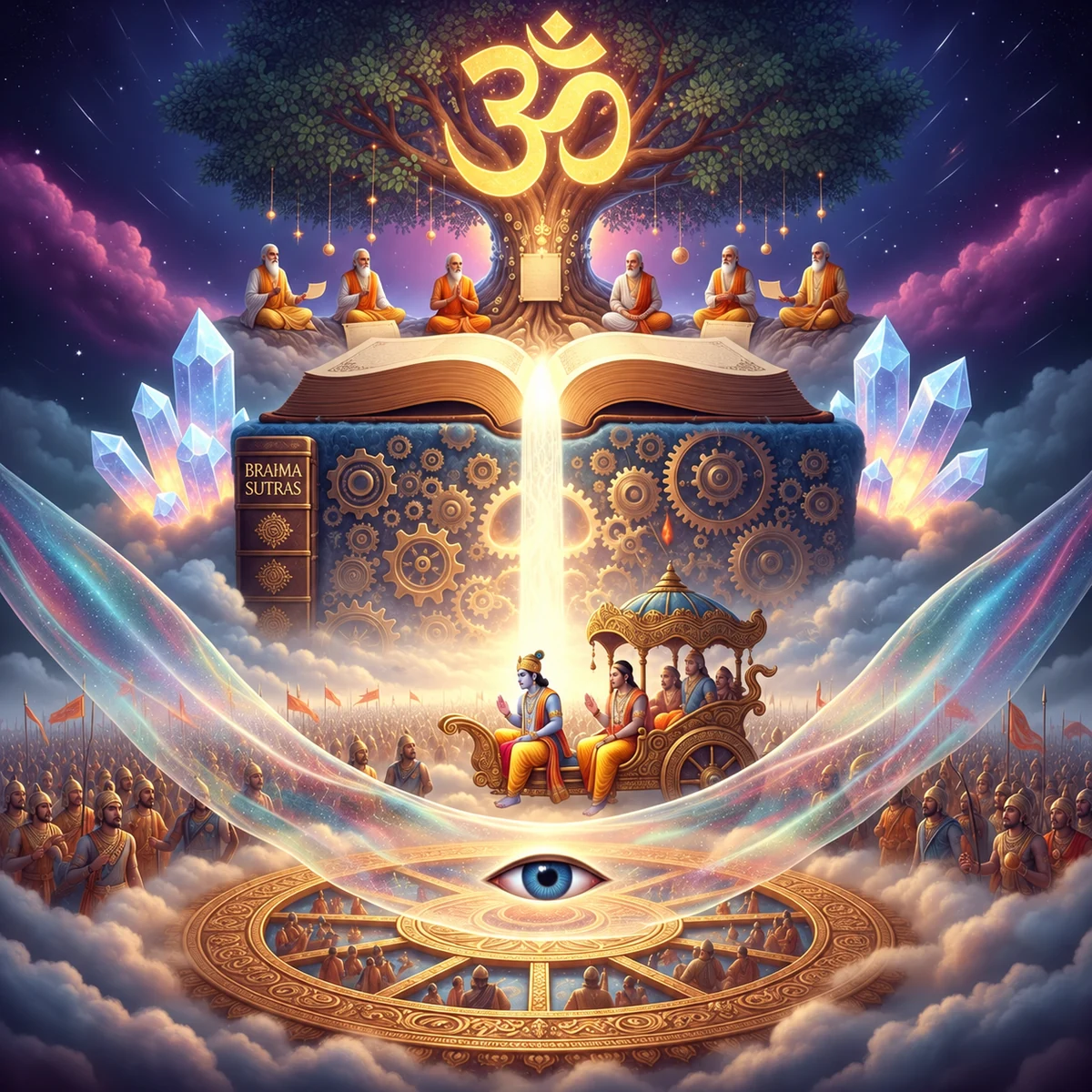
Your existence is already evident. The inquiry now turns to steady wisdom and to the traditional accounts of karma and rebirth, while keeping practical agency distinct from Ātman.
The Gita specifically describes the state of a person who has finally pierced through Maya—the “person of steady wisdom” (Sthitaprajna).
The Sthitaprajna is a person of steady wisdom. In the Advaita reading explored here, the point is clear self-knowledge expressed through life, rather than treating duty as an attribute of Ātman.
Chapter 2 of the Gita explores steady wisdom. This series connects that discussion with the Upanishadic inquiry and the Brahma Sutras, without making Ātman an acting agent.
Characteristics of the Sthitaprajna (The Steady Soul)
1. Withdrawal of the Senses
The Gita uses the famous analogy of the tortoise. Just as a tortoise pulls its limbs into its shell when it senses danger, the man of wisdom can withdraw his senses from the “objects” of the world.
- The Connection: This isn’t about running away to a cave; it’s about the logical realization (from the Brahma Sutras) that “I am the Witness, not the experiencer.”
2. Equality in All Conditions (Samatvam)
Because this person recognizes that their existence is eternal and independent of the physical world, they remain the same in:
- Pleasure and Pain
- Victory and Defeat
- Gold and Stone They realize that these are just “modifications of Maya” (the shifting of matter), while the Atman remains untouched.
3. Freedom from “I” and “Mine”
The shift concerns release from mistaken identification, rather than the disappearance of every practical use of “I.”
- The Realization: “I do not act; the modes of nature (Gunas) are acting upon themselves.”
- Action can continue with care and discernment, without being claimed as the achievement of an independently existing self.
The “Ladder of Fall” vs. The “Ascent of Wisdom”
The Gita explains that if we don’t understand this connection, we fall down a specific psychological ladder. This provides the “Why” behind the logic of the Brahma Sutras:
- Contemplation: You think about an object.
- Attachment: You develop a “need” for it.
- Desire: The need becomes a craving.
- Anger: If the desire isn’t met, you get angry.
- Delusion: Anger clouds your judgment (Maya).
- Loss of Memory: You forget your true nature and your duty.
- Destruction of Reason: Your logic (the Brahma Sutras in your head) fails.
Conclusion: The Unified Philosophy
To bring our entire conversation together, the relationship between these three pillars of wisdom is a journey of the self:
- The Upanishads give you the Vision: You are not this body; you are the Infinite.
- The Brahma Sutras provide the Logic: Here is why that is true, why your consciousness is independent, and how the illusion of “I” is formed.
- The Bhagavad Gita brings self-knowledge into the question of responsible action, without attributing action to limitless Ātman.
You exist; life calls for response. How to act? This is a practical question for the individual. It does not mean that Awareness is compelled to act or that Brahman is divided among individual roles.
The Brahma Sutras discuss the individual, karma and rebirth within the scriptural teaching. That account should be distinguished from Ātman, which is not a travelling object, and from claims of a modern scientific demonstration.
1. Karma and Rebirth in the Traditional Account
The traditional discussion concerns continuity of the individual and the consequences of action. In Advaita, that discussion belongs to the account of dependent appearance; it does not make Ātman subject to movement.
- The Problem of Inequality: Why is one person born into wealth and health, and another into suffering?
- The Logical Answer: The Sutras argue that if life were “one and done,” God or the Universe would be arbitrary and cruel. Reincarnation explains that our current “existence” is a continuation of previous actions.
- Teaching and Physical Explanation: Karma and rebirth belong here to the traditional account of the individual and the subtle body. Physical energy conservation does not, by itself, establish that account. This series can explore the teaching without presenting a physical analogy as its proof.
2. The Individual and the Subtle Body
Traditional accounts describe the individual’s passage with the Sukshma Sharira, the subtle body. In the Advaita standpoint, this concerns the jiva and its conditioning; Ātman itself does not depart from one place and arrive at another.
- The Subtle Body: This includes the mind, the senses, and the “life force” (Prana).
- Impressions and Karma: Vasanas name habitual impressions within the traditional account of the subtle body. The image can invite reflection on conditioning; it is not a mechanism established by physical measurement.
3. The Gita’s Famous Metaphor
The Bhagavad Gita presents the familiar clothing analogy at 2.22. Read it within the traditional discussion of embodiment, rather than as a claim that Ātman physically travels:
“Just as a person casts off worn-out garments and puts on new ones, so the soul casts off worn-out bodies and enters into others that are new.” (Gita 2.22)
4. Reincarnation and the “Duty of Existence”
Within the traditional account, rebirth concerns karma, ignorance and identification; it should not be reduced to the idea that every unfinished personal task requires another lifetime. The immediate inquiry is how attachment shapes action now, and what the teaching reveals about the one who claims to act.
- The Image: A traveller and a road can illustrate the individual’s journey; the image does not define Ātman as a moving entity.
- The Traditional Account: Karma and rebirth concern the individual’s conditioning and the consequences of action.
- The Bhagavad Gita says: Don’t worry about how long the road is; just take the right step (perform your duty) today.
The Ultimate Goal: Ending the Cycle
From the Advaita standpoint, Ātman has not departed from Brahman and does not need to travel back. Liberation is self-knowledge: the removal of the error that makes what is limitless appear to be a separate, incomplete self. A wave does not need to become water. The recognition concerns what has always been the case. Ordinary life continues, and understanding gives it expression.
Summary of our journey:
We have explored action, identification and steady wisdom, alongside the traditional account of karma and rebirth. The concluding part turns to moksha: self-knowledge and the removal of error, rather than the production of a new Self.
Further Reading
For the distinction between agency and the Self, see Sivananda’s commentary on Brahma Sutra 2.3.40. For preparation, self-knowledge and liberation, see Chapter 3, Section 4, particularly 3.4.26 and 3.4.52. Read the arguments together with their replies.
Leave a Reply