Vedanta study series — Part 2 of 4. Part 2 explores descriptions of Brahman, māyā and identification, and their relationship to action.
Teaching standpoint: This series explores an Advaita interpretation and uses contemporary analogies to connect the texts with James Traverse’s teaching. These summaries are not literal quotations from particular sutras; other Vedanta traditions interpret the texts differently.
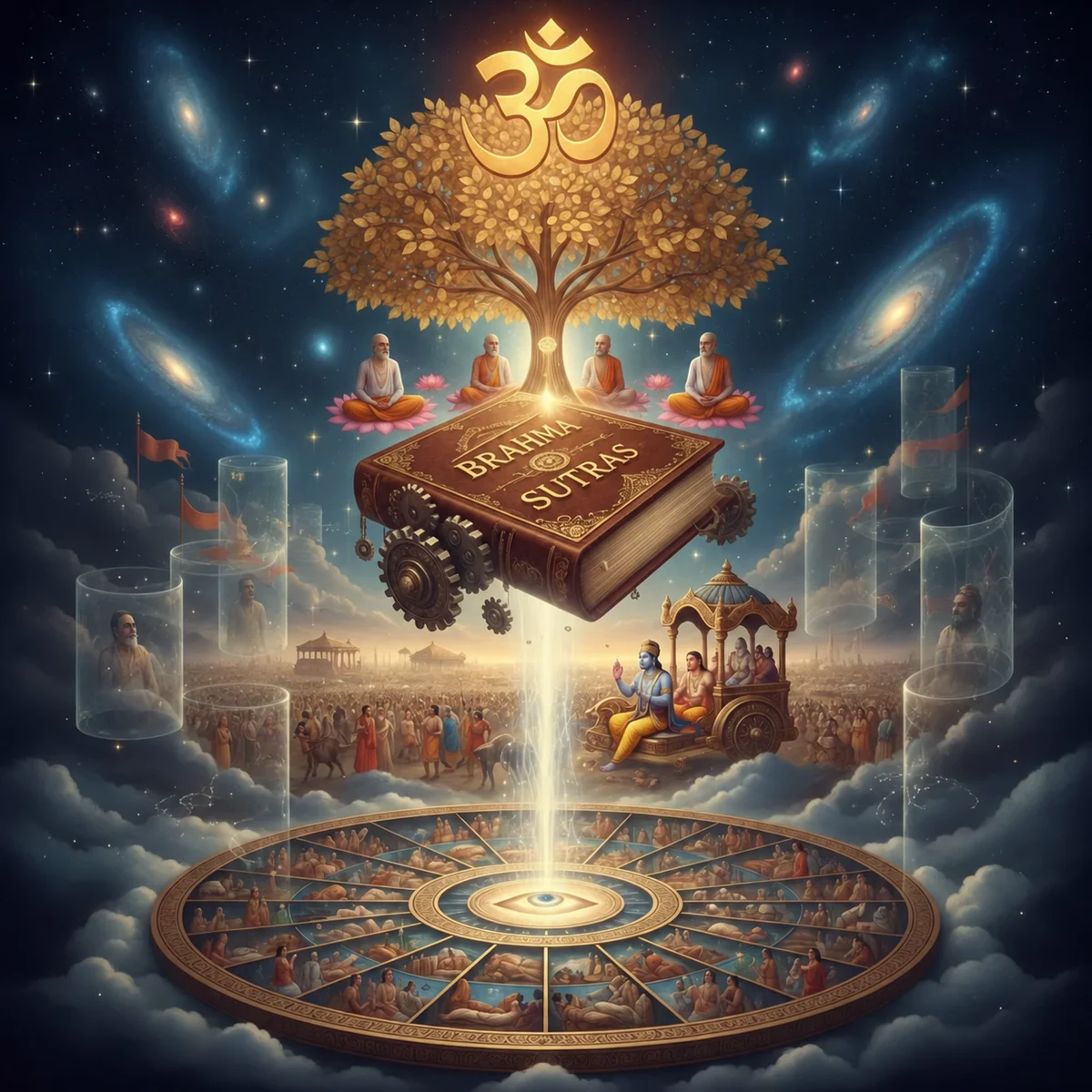
Brahma Sutras – the logical “judge” between the Upanishads and the Gita
To illustrate how the Brahma Sutras act as the logical “judge” between the Upanishads and the Gita, let’s look at one of the most famous philosophical debates: Is the Ultimate Reality (Brahman) with attributes or without them?
The Conflict: Two Faces of Truth
The Conflict: Two Faces of Truth
In the Upanishads, you find two types of descriptions:
- Nirguna Brahman: The “Attribute-less” Absolute. (e.g., “It is neither thick nor thin, neither short nor long…”)
- Saguna Brahman: The “Personal” God with attributes. (e.g., “He who knows all, who is all-powerful…”)
To a logical mind, both cannot be true at the same level. If God is formless, how can He have a form? If the soul is “One” with God, how can it also “serve” God?
The Brahma Sutra’s Logical Solution
In the Advaita interpretation explored here, differing descriptions are considered through their teaching standpoint. Nirguna points to Brahman without limiting attributes; the account of Ishvara concerns the universe and its order.
- The Teaching Standpoint: Brahman is not divided into two realities. The account of Ishvara and the account of attribute-free Brahman serve different purposes within the inquiry.
- The Analogy: Just as the same sunlight appears red at sunset and white at noon, or as a single actor plays different roles, the Truth is one, but perceived differently based on the observer’s “lens.”
How the Gita Applies This Logic
The Bhagavad Gita explores devotion, the unmanifest and the question of action through Arjuna’s inquiry. Reading the texts together can clarify their relationship; this is not a claim that the Gita historically derived its teaching from the Brahma Sutras.
In Chapter 12, Arjuna asks Krishna the exact same question the Brahma Sutras address: “Who is better—those who worship You as a Person, or those who worship the Unmanifested/Formless?”
Krishna’s answer is the perfect “lived” version of the Brahma Sutra logic:
- The Theoretical Truth: Both paths lead to the same goal (The Brahma Sutra’s “Harmony”).
- The Human Reality: Worshiping the “Formless” is much harder for a being who has a body.
- The Mandate: Therefore, act with devotion to the “Personal” (the duty in front of you) while knowing the “Formless” is the ultimate truth.
The Synthesis: The Integrated Path
The connection between these three creates a complete spiritual “Operating System”:
- Upanishads (The Core): Direct the inquiry toward self-knowledge and the mistaken limitation attributed to Ātman.
- Brahma Sutras (The Processor): Examine meaning, objections and consistency within the Vedanta teaching.
- Bhagavad Gita (The Output): Brings the inquiry into action and responsibility. The individual acts; Ātman is not an agent compelled to perform duties.
The Resulting Perspective on Duty
The image of a cell within a body can help us consider relationship and responsibility. It is a teaching image, not a division of Brahman into pieces. Ātman names the truth of the individual; Brahman names limitless Reality. The two terms provide different teaching standpoints without establishing two Awarenesses. Source and how it appears are not-two.
- The Image: A cell within a body illustrates relationship; it does not establish Ātman as a fragment of Brahman.
- The Distinction: Traditional discussion of the individual, death and rebirth should not be confused with the limitless nature of Ātman.
- The Practical Question: What does this situation require, and can it be met without clinging to a separate personal claim?
Maya
Even when the teaching is heard, identification can shape how we understand ourselves and how we act. The following discussion uses the Advaita account of Maya to explore that confusion.
What is Maya?
In Advaita, Maya helps explain appearance and the seeming limitation of what is limitless. It does not mean that experienced life is simply non-existent. This is a teaching summary, not a quoted definition from a particular sutra.
- The Power of Veiling (Avarana): It hides the truth of your existence as the eternal Atman.
- The Power of Projection (Vikshepa): It projects a false reality—the idea that you are just a body, a name, and a social status.
How the Brahma Sutras Explain the “Forgetfulness”
Shankara’s introduction to his Brahma Sutras commentary examines Adhyasa, superimposition. The examples below illustrate the confusion of the Self with the body-mind.
- The Superimposition (Adhyasa): Here the issue is the mistaken transfer of attributes between Self and not-Self. We mix up the qualities of the Subject (the Soul) and the Object (the Body).
- Because the body is hungry, we say “I am hungry.”
- Because the body is aging, we say “I am dying.”
- The Error of Identity: We transfer the limitations of the body onto the limitless soul. This “error” is what causes the crisis of duty. Arjuna’s grief came from identifying with his family’s physical forms rather than their eternal existence.
The Connection: Action as Preparation for Self-Knowledge
Action, reflection and study have related but distinct roles. How can action prepare us to hear and understand the teaching clearly?
- Knowledge (Upanishads): You study the truth that you are not the body.
- Logic (Brahma Sutras): You use reason to confirm that your existence is independent of the world.
- Action (Gita): You perform your duty.
Acting with care, while releasing the demand for a personal reward, can make the mind more available to inquiry. Karma Yoga prepares; self-knowledge removes the mistaken identification. In James’s expression, the teaching flowers as Knowing via Being: understanding is evident in how we listen, relate and act. Freedom is not manufactured by maintaining a special condition of mind.
The Insight: Seeing mistaken identification does not require the destruction of practical personhood. A name, a role and a responsibility can remain useful without being taken as the whole truth of “I.”
Summary of the Triple Connection
| Step | Text | Logical Function |
| The Fact | Upanishads | “I am Brahman.” (The Soul is the only true existence.) |
| The Obstacle | Brahma Sutras | “Maya causes Adhyasa.” (You are confused by a logical error of identity.) |
| The Solution | Bhagavad Gita | Act with care and without clinging; let action prepare the mind for self-knowledge. |
Your existence is already evident; action does not prove it into being. The inquiry concerns how you understand yourself and how that understanding is expressed in life.
For the distinction between agency and the Self, see Sivananda’s commentary on Brahma Sutra 2.3.40. For preparation, self-knowledge and liberation, see Chapter 3, Section 4, particularly 3.4.26 and 3.4.52. Read the arguments together with their replies.
Leave a Reply