In our hyper-individualistic age, the quest to “find oneself” has become a modern industry.
We treat the self as a hidden treasure buried under layers of childhood trauma, personality archetypes, and career milestones.
We take Myers-Briggs tests, travel to ashrams, and curate our identities, hoping that if we just gather enough data, the “real me” will finally emerge.
But Advaita Vedanta offers a subversive correction: the reason you cannot “find” yourself is that you were never lost.
The self is not a destination to be reached or a mystery to be solved through more experience. It is the one constant in every experience you have ever had. The spiritual journey is not an additive process of finding something new; it is a systematic dismantling of the lies you believe about what is already here.
1. Your Personality is an Object, Not Your Identity
Most people mistake self-knowledge for what Vedanta calls relative knowledge.
This includes your psychological profile, your history, and your emotional tendencies.
While this data is useful for navigating the world, it is ultimately knowledge of objects—subtle objects like thoughts and memories, but objects nonetheless.
True self-knowledge (Ātma-Jñānam) is the recognition of your nature as the Ātmā, which is identical to the limitless Brahman.
This Self is pure, attributeless, all-pervasive consciousness.
When you identify with your “story,” you are identifying with the Anātmā (the not-self).
This is the primary source of human suffering: we mistake the character on the screen for the screen itself.
The word Upaniṣad means “that which is nearest” (upa-ni-sad).
The Self is not a distant goal; it is the nearest thing to you, closer than your own body, yet hidden by the very proximity we overlook.
2. If You Can See It, It Isn’t You
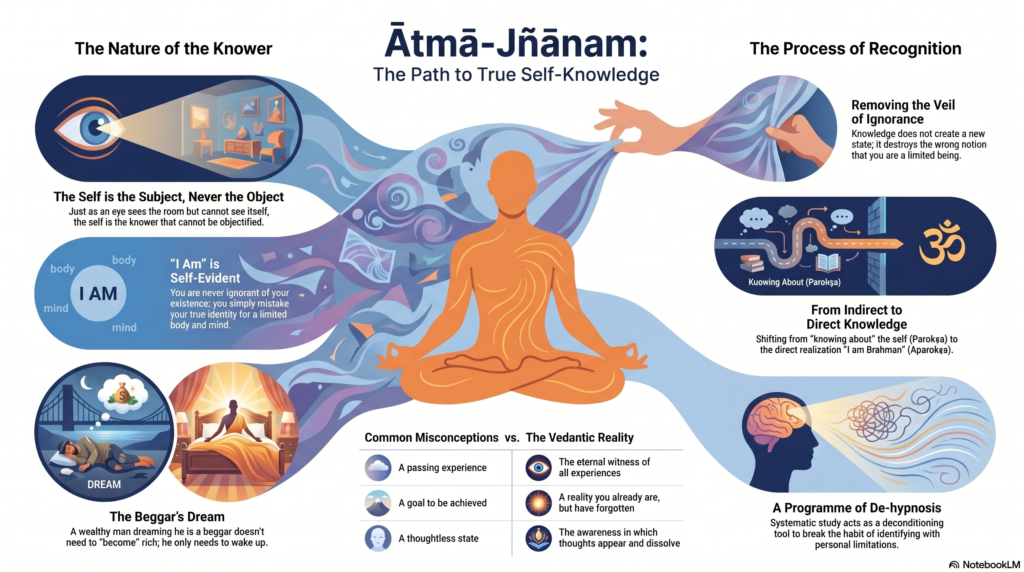
In every act of knowing, there is a triple distinction: the knower (Pramātā), the means of knowledge (Pramāṇa), and the object being known (Prameya).
When you look at a tree, your eyes (the means) reveal the tree (the object) to you (the knower).
Self-knowledge is unique because it collapses this structure.
The Self cannot be an object of knowledge because it is the ultimate Subject.
Consider the eye: it can see the entire world, but it cannot see itself directly. It doesn’t need to “see” itself to prove it exists; its very act of seeing is the proof.
If you are frustrated in meditation because you cannot “find” or “grasp” your true nature, understand this: your inability to objectify the Self is the ultimate proof of its presence.
You cannot see the Seer because you are the Seer.
3. You are a Wealthy Person Dreaming of Poverty
We are conditioned to believe that enlightenment is something to be attained through rigorous effort.
Vedanta suggests that the “I am” is already self-evident.
You are never ignorant of your own existence; you are only ignorant of your nature.
Think of a wealthy person who dreams they are a beggar. In the dream, they may pray for money or work hard to escape poverty.
When they wake up, they don’t become wealthy—they simply recognize that they were wealthy all along.
They didn’t need a “wealth-gaining experience”; they only needed to remove the “wrong notion” of being a beggar.
This is the shift from becoming to recognizing.
You do not need to improve yourself to reach Brahman; you only need to stop pretending to be a limited body-mind.
As Swami Dayananda emphasizes, “I am” is experienced all the time. You don’t lack the experience of the Self; you are the experience in which all other experiences occur.
4. Knowledge is a “De-Hypnosis” Programme
We have hypnotized ourselves into believing we are mortal, inadequate, and separate.
Vedanta acts as a Pramāṇa—a unique means of knowledge—that functions as a “de-hypnosis” programme.
This process involves a transition from Parokṣa-Jñāna (indirect knowledge) to Aparokṣa-Jñāna (direct recognition).
Indirect knowledge is like having a map of a city; you know about it, but you aren’t there.
Direct recognition is the arrival. It is the “Aha!” moment where the gap between the teaching and the student collapses.
This knowledge negates our perceptions without necessarily changing them.
Consider the bent-stick analogy: when you place a stick in water, it appears bent.
Even after you know the stick is straight, your eyes continue to report a “bent” stick.
However, you are no longer fooled.
You “know” the truth even while the appearance persists.
Similarly, even as the body feels pain or the mind feels fear, the “de-hypnotized” individual knows: “I am the changeless consciousness in which this sensation appears.”
To clarify this “subtractive” process, we must distinguish between what self-knowledge is and what it is not:
| The Misconception | The Vedantic Clarification |
| An experience | Knowledge is not a peak experience that “happens.” The Self is the witness of all experiences, both peak and mundane. |
| A thoughtless state | Silence is a temporary state of mind. Real knowledge is a cognition that remains true even when thoughts return. |
| An achievement | You don’t “become” Brahman. You recognize you have always been Brahman. |
| A technique | Meditation and breathwork are preparatory aids. Only knowledge removes the root cause of ignorance. |
| Academic study | Indirect Knowledge (The Map) is not the same as Direct Recognition (The Arrival). |
5. The Ego’s Final Act
The ultimate paradox of Advaita is the question: Who gains this knowledge?
Brahman cannot gain knowledge, for Brahman is already all-knowing and changeless.
The body cannot gain knowledge, for it is inert. The one who gains knowledge is the Reflected Consciousness—the ego (Ahaṁkāra).
The ego must undergo a specific cognition called Vṛtti-jñāna—a thought-form that says, “I am Brahman.”
This is explained through the mirror analogy: your reflection in a mirror is not you, but it points to you.
When the reflection “understands” it is actually you, the reflection doesn’t physically merge into you; it simply loses its claim to a separate existence.
The “I am Brahman” thought is the ego’s final act. It is a thought that, once fully assimilated, dissolves the thinker.
The ego realizes it was never a separate entity, but merely a reflection of the original, unchanging light.
Conclusion: The Tree that Cannot Regrow
The culmination of this recognition is Mokṣa—complete freedom.
Vedanta describes our life of habitual suffering as the “tree of saṁsāra.”
Traditional self-help tries to prune the branches—fixing your anxiety, fixing your relationships, fixing your productivity. Vedanta cuts the root.
When the root of self-ignorance is severed by knowledge, the tree of sorrow is effectively dead.
While the “trunk and branches” of your past patterns and karma may persist for a time—much like the stick that still looks bent in the water—they can no longer bear the fruit of suffering.
You no longer see yourself as a fragment struggling for completion; you see yourself as the Whole.
The next time you feel the weight of daily anxiety, try the practice suggested by Swami Paramarthananda: Stop at the words “I am.”
When you say “I am tired,” “I am a failure,” or “I am mortal,” you have already re-hypnotized yourself by attaching the Self to the Not-Self.
But if you can stop at the “I am” and refuse to add the labels of the ego, what remains?
What remains is the immortality that was never lost, and therefore, never needed to be found.
Note: What is Brahman?
In Advaita Vedanta, Brahman is defined as your own true nature—the self (ātmā)—which is described as pure, attributeless, all-pervasive consciousness.
It is not a deity to be worshipped or a distant goal to be reached, but the very reality of who you are once mistaken identities are removed.
Based on the sources, Brahman can be understood through several key characteristics:
1. The Nature of Brahman
Brahman is limitless, whole, and complete. It is often described as sat-cit-ānanda (Existence-Consciousness-Bliss). Unlike the body or mind, which change and eventually perish, Brahman is immortal, changeless, and always free. It does not “gain” knowledge or undergo any transition because it is already the fullness of existence.
2. Identity with the Self
A central tenet of the sources is that there is no difference between the individual self (Ātmā) and Brahman.
- The “Whole” vs. the “Part”: You are not a small part of the universe struggling to become complete; you are the whole.
- Already Attained: You do not become Brahman through practice; you already are Brahman. Self-knowledge is simply the recognition of this existing fact.
3. Beyond Objectification
Brahman cannot be “seen” or “known” as an object because it is the subject—the ultimate “seer” or witness of all experiences. While you can have knowledge about Brahman (indirect knowledge), direct knowledge is the collapse of the gap between “you” and Brahman, leading to the realization: “ahaṁ brahmāsmi” (I am Brahman).
4. The Relationship to the World
The sources explain that while the “story” of your life, personality, and emotions appears to be real, it is actually a set of patterns appearing within the self. Brahman is the awareness in which all these stories appear and dissolve. When this is realized, you see that everything is in you and you are never separate from yourself.
In summary, Brahman is the limitless reality that serves as the substratum for your entire existence. It is the “waker” that you recognize yourself to be once you “de-hypnotize” yourself from the dream of being a limited, mortal person.
A Guided Meditation
This guided meditation is designed to lead you through the process of “de-hypnosis” described in the sources, moving from an identification with your limited personality toward the recognition of your true nature as limitless awareness.
The Recognition of Being: A Guided Meditation
1. Preparation and Grounding Find a comfortable position and gently close your eyes. Begin by setting aside the need to achieve anything. This is not a technique to change yourself, but a process of recognition. Take a deep breath and notice the simple, fundamental fact of your own existence. Before you think about who you are, just sit with the undeniable truth: “I am”.
2. Observing the Not-Self (Anātmā) Shift your attention to your body. Notice the sensations—the weight of your limbs, the rhythm of your breath. These are objects of your perception. Because you can observe them, you cannot be them,. Now, observe your thoughts and emotions. Notice how they arise, linger, and dissolve. These, too, are subtle objects. They are like reflections in a mirror; they appear within you, but they do not define or change you. Mentally step back and recognize: “I am the seer of these thoughts, not the thoughts themselves”.
3. Resting in the Self-Evident Focus on the awareness that is present regardless of what you are thinking or feeling. This awareness is self-evident; it requires no effort to find because it is the very “knower” that is always here. Just as your eyes see the room but cannot see themselves directly, you are the subject that witnesses everything else. Rest in this “I am” that exists prior to any story or label.
4. The Process of De-Hypnosis Consider the “story” of your life—your name, your roles, your history, and your personality. In Vedanta, these are like a dream where a wealthy person imagines they are a beggar. You have been hypnotized into believing you are a limited, mortal person named “John” or “Mary”. Quietly tell yourself: “These are stories appearing in me, but they are not me. I am the awareness in which these stories appear and dissolve”. You are not a part of the universe struggling to be whole; you are the limitless whole.
5. Claiming Your Nature as Brahman Recognize that this awareness is not small or confined to your body. It is Brahman—pure, attributeless, and all-pervasive,. It is sat-cit-ānanda: Existence, Consciousness, and Bliss. Allow the gap between “you” and the “limitless” to collapse. There is no distance to travel. Realize: “Ahaṁ brahmāsmi” — I am Brahman,. You are the “waker” who has finally recognized the dream for what it is.
6. Conclusion As you prepare to end this meditation, remember that you are never away from yourself. This recognition does not require a special state of mind or a lack of thoughts. Whether you are sitting in silence or fully engaged in life, you remain the changeless witness, the screen upon which the movie of life is projected.
Gently open your eyes, carrying the understanding that you are already full, complete, and free
Waking Up to Reality https://www.youtube.com/watch?v=zlmoYFaj5oU
Pingback: The Silent Answer to Hamlet’s Great Question -
Pingback: Yoga Beyond the Mat: A Modern Guide to Spiritual Awakening
Pingback: Awakening the Soul: Spiritual Awakening Yoga Practises -
Pingback: Breathing: the Link Between the Body and the Mind -