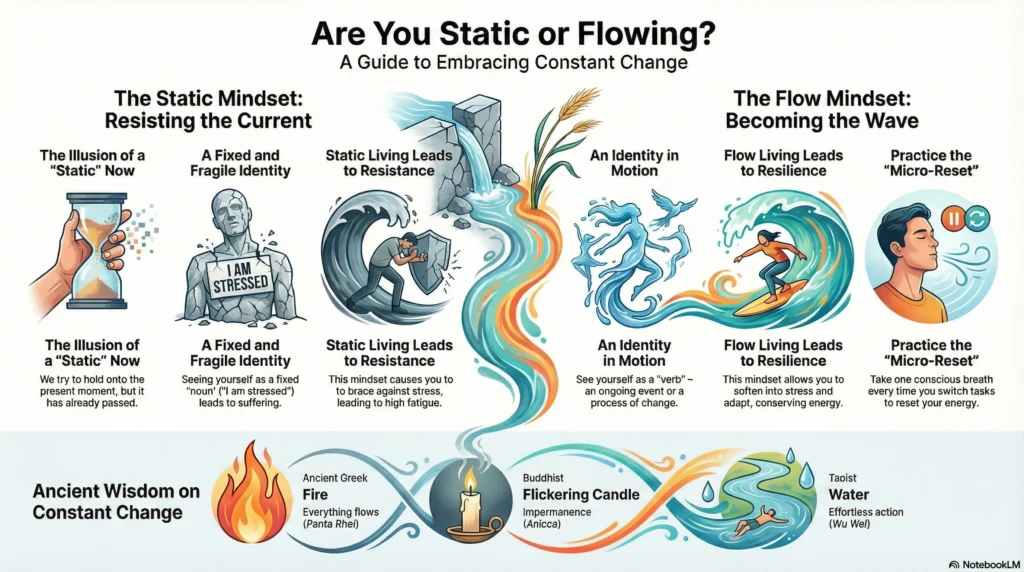
Have you ever tried to catch the “now”? By the time you think about the present, it has already slipped into the past. We often imagine time as a series of frozen snapshots—like frames in a film—but a deeper look into physics, philosophy, and neuroscience suggests a different reality. The present moment isn’t a frozen point in time; it is a seamless, dynamic process.
Understanding why the “static now” is an illusion can change how you perceive your life and the universe around you.
The Illusion of the Static “Now”
Our intuition often tells us that the present is a razor-thin slice of reality, separating a fixed past from an uncertain future. This view, known as Presentism, suggests that only the current moment exists. However, treating the present as a “frozen point” leads to significant logical and scientific contradictions.
If time were truly made of frozen, indivisible instants, motion itself would become impossible. This is the heart of Zeno’s Paradox of the Arrow. Zeno argued that at any given “instant,” an arrow in flight is in a space exactly its own size. If it is occupying a specific space at a specific instant, it is, by definition, at rest. If the arrow is at rest at every instant of its flight, it can never actually move.
The resolution to this paradox isn’t found in better snapshots, but in realizing that time is not a collection of static points.
The “Specious Present”: Why Your Brain Rejects the Snapshot
From a biological and psychological perspective, we don’t even experience the world in frozen points. Philosophers and psychologists use the term “Specious Present” to describe the “thick” conception of time perception.
Unlike a “thin” mathematical point with no duration, our perceived present lasts for a short stretch of physical time. This allows us to:
- Perceive Motion: We don’t see a series of still images; we see continuous movement because our consciousness holds onto a “just-past” while anticipating a “just-about-to-be”.
- Understand Language and Music: You don’t hear a song as a single note; you hear the relationship between notes over a duration.
Your brain essentially “buffers” reality, creating a seamless flow rather than a jerky slideshow.
Physics and the Flow of Constant Change
Modern physics further dismantles the idea of a universal, frozen “now.” Albert Einstein’s Theory of Relativity showed that there is no absolute simultaneity. Two people moving at different speeds will not agree on what constitutes “the present moment”.
If “now” is different for everyone depending on their location and speed, then the present cannot be a single, objective “frozen point” in the universe. Instead, many physicists lean toward the Block Universe model (Eternalism), where past, present, and future coexist as a four-dimensional whole.
Alternatively, emerging theories like those proposed by Julian Barbour suggest that while “Nows” exist as unique configurations of the universe, they are not links in a chain. Instead, the impression of the “passage of time” arises from how these configurations relate to one another—like a landscape we are walking through rather than a clock ticking away.
Life as a Continuous Process
If the present isn’t a frozen point, what is it? It is better understood as Flow.
Ancient philosophies, such as the Greek concept of Panta Rhei (everything flows) and the Buddhist principle of Anicca (impermanence), have long argued that change is the only constant. In this view, you are not a static object moving through time; you are a process that never actually stops.
- Identity as Flow: Just as a river is never the same twice, your “self” is a continuous transition of energy, thoughts, and cells.
- Presence as Connection: Embracing the present doesn’t mean trying to “freeze” a happy moment. It means tuning into the constant change and “becoming the wave” of experience.
Frequently Asked Questions Regarding: Why the Present Moment Isn’t a Frozen Point in Time
1. What does it mean that the present isn’t a “frozen point”? It means that “now” is not an indivisible, static snapshot like a single frame of a film. Instead, both our physical reality and our mental perception require duration. Without a “thick” present that contains a bit of the past and a hint of the future, movement and change would be mathematically and experientially impossible.
2. What is the “Specious Present”? Coined by E.R. Clay and popularized by William James, the specious present is the idea that our perception of “now” actually has a duration (usually cited as a few seconds). This allows us to perceive a melody as a sequence or a car as “moving” rather than just being in different spots.
3. How does Zeno’s Paradox of the Arrow relate to this? Zeno argued that if time is made of frozen instants, an arrow is always “at rest” in its specific location at any given moment. Therefore, it can never move. The solution lies in realizing the present isn’t a frozen point; it is an inherently dynamic transition.
4. Does physics support the idea of a “frozen now”? Actually, Einstein’s Theory of Relativity challenges a universal “now.” Because simultaneity is relative to the observer’s speed and position, there is no single, objective “frozen point” that everyone in the universe agrees is the present.
People Also Ask
- Is the present moment an illusion?
- Answer: In physics, particularly the “Block Universe” model, the specific “nowness” of the present is often considered a subjective illusion of human consciousness, as all points in time (past, present, and future) are equally real.
- How long does the present moment last?
- Answer: Psychologically, the “specious present” lasts between 0.5 to 3 seconds. Physically, however, some theories of “discrete time” suggest a Planck time unit, though most classical physics treats time as a continuous flow without a specific “length” for the now.
Summary: Embracing the Dynamic Now – Why the Present Moment Isn’t a Frozen Point in Time
The present moment isn’t a frozen point in time to be captured; it is a living process to be experienced. When we stop trying to “freeze” time, we align ourselves with the true nature of the universe—a seamless, ever-changing flow where the past and future are always woven into the vibrant texture of the “Timeless Now“.
Leave a Reply