1. Introduction: The Exhausting Search for Who You Already Are
Most modern seekers approach enlightenment as if they are downloading a new app or installing a third-party plugin to “fix” their experience.
They treat the Self as a destination to be reached through exhausting effort. In the architecture of Vedāntic thought, this is a fundamental “category error.”
Self-knowledge isn’t a journey toward a new location; it is a systemic shift in attention—a “System Reinstallation” of your cognitive interface.
The reason most people fail to sustain peace is that they attempt these recognitions with an “unprepared” mind.
To bridge the gap between ancient wisdom and modern psychological application, we must address the missing links: the Qualified Mind (sādhanā catuṣṭaya) and Direct Recognition (pratyabhijñā).
You don’t need more information; you need to debug the ego’s software so you can see what has been there all along.
2. Stop Looking for an Elephant: The Power of Direct Recognition
To understand why you haven’t “found” yourself, we must distinguish between three distinct cognitive background processes:
- Cognition: Learning something for the first time (e.g., your first encounter with an elephant).
- Remembrance: Recalling an object from memory when it is absent.
- Recognition (Pratyabhijñā): Identifying a present object as the same one previously known (“This is that same elephant from yesterday”).
Recognition requires that the object is currently within your perception but has been habitually overlooked.
You have been experiencing consciousness every second of your life, but you fail to recognize it because your “User Interface” is cluttered with objects.
Consider the “Spectacles” Paradox:
You look through your glasses to see the world, but you never look at the glasses.
They are the most present thing in your field of vision, yet they are ignored because they are the instrument of seeing.
Similarly, we focus on thoughts and ignore the “Light” that makes them visible.
“When I ask what is here, you will say ‘hand’, ‘lines’, ‘nails’.
You will tell everything except the most important thing — the light because of which you see the hand.
When I talk about the light, you are not experiencing a new thing.
You are turning your attention to something that is all the time experienced.”
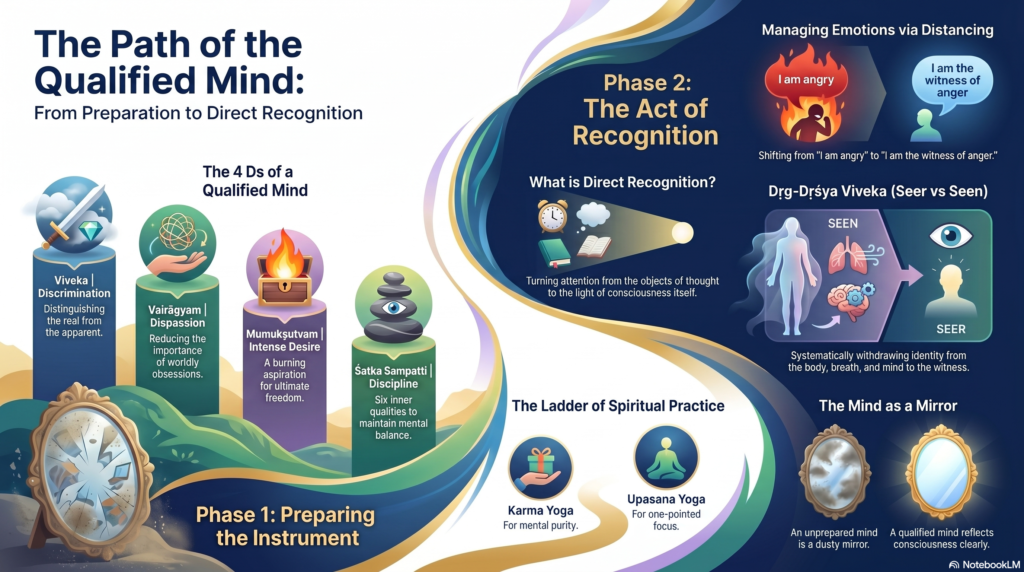
3. The “4 D” Checklist: Identity Architecture
The mind is the “instrument” of knowledge. If the hardware is glitchy or the processor is overheated by desire, it cannot serve as a locus for recognition.
A “Qualified Mind” is the result of a rigorous debugging process known as the sādhanā catuṣṭaya:
- Discrimination (Viveka): The capacity for “Cognitive Debugging.” It is the ability to distinguish between the real goal of life (nihśreyasa or liberation) and the “fake goals” (preyas) of temporary pleasure.
- Dispassion (Vairāgyam): The result of high-level discrimination. This involves reducing the “undue importance” of temporary objects, effectively clearing the mental cache of obsessive clinging.
- Desire (Mumukṣutvam): The “System Priority.” An intense longing for liberation that outweighs the desire for gross sense pleasures.
- Discipline (Śatka Sampatti): A suite of internal tools, the most crucial being Śraddhā—maintaining an open mind and the patience to allow the teaching to “buffer” until it is fully understood.
4. The Language Hack: Debugging the Ego’s Software
The ego operates on a flawed syntax: “I am angry” or “I am anxious.”
This identifies the “Subject” (dṛk) with the “Object” (dṛśya), creating a fatal error in your identity architecture.
The “Secondary Reaction” Error: The most common “recursive error” in the seeker’s mind is getting angry about being angry, or anxious about having anxiety.
This is a secondary reaction that traps the mind in a loop. By standing aloof as the Witness (sākṣī), you recognize that the mind can never be totally free of flare-ups, but those flare-ups don’t belong to you.
Manual Overrides for Emotional Management:
- Language Distancing: Shift from “I am angry” (identifying with the ego) to “I am aware of anger” (identifying with the witness). This immediately reduces emotional intensity.
- FIR Metric: Measure your mental health by tracking the Frequency of disturbances, the Intensity of the reaction, and the Recovery period.
- TDS (Thought Displacement Skill): Use a mantra or japa as a manual override. This skill allows you to instantly displace a negative thought-stream (rāga/dveṣa vṛtti) with a chosen focus, starving the emotional “whirlpool” of its fuel.
“When you say ‘I am angry’, the word I means ahamkaaraa… on the other hand, if you can say ‘I am not angry; but I am aware of the mind, which has anger thought’, the meaning of the word ‘I’ is the saakshi.”
5. Moving from “Triangular” to “Binary”: System Reinstallation
Most spiritual seekers operate on a “Legacy System” (The Triangular Format):
- The Seeker (I)
- The Goal (Peace/Self)
- The Effort (The journey to bridge the gap)
This format ensures you never “arrive” because the structure itself implies a distance. The “Binary Format” is the mandatory system reinstallation:
- I am Awareness (The only reality/The Screen).
- The world/mind/body (Temporary appearances within the Screen).
In the Binary Format, the search ends. You don’t have to “reach” the water; you recognize that you are the water, and the whirlpool of the mind is merely an incidental form it takes.
6. Standing on the Bank: Mastering the Whirlpool of Life
Life is a turbulent river. Niṣkāma Karma Yoga (performing duty as an offering) acts as a “stable chain” fixed to the bank. By holding this chain, you can experience the current without being swept away.
To help the mind recognize the subtle “Light” behind the gross “Hand,” we use Arundhatī darśana nyāya—the method of pointing to a tiny, subtle star by first directing attention to the bigger, grosser stars near it.
This is why we use the Pañca-kośa (five sheaths) model to gradually withdraw attention inward:
| Stage | Dṛśya (Seen / Object) | Dṛk (Seer / Subject) | Practical Exercise |
| Gross Body | Annamaya kośa | Consciousness aware of body | “I am not the body; I observe it” |
| Life Force | Prāṇamaya kośa | Consciousness aware of breath | “I am not the breath; I observe it” |
| Mind/Emotions | Manomaya kośa | Consciousness aware of thoughts | “I am not the emotion; I observe it” |
| Intellect | Vijñānamaya kośa | Consciousness aware of decisions | “I am not the decision; I observe it” |
| Bliss/Deep Sleep | Ānandamaya kośa | Consciousness aware of peace | “I am the knower of even this peace” |
| RECOGNITION | All appearances are Mithyā | Pure Witness (Brahman) | “I am that Awareness” |
7. Conclusion: The Water Was Always There
To find the Self, apply the “Diver’s Technique.”
Just as a diver plunges through layers of water to find an unseen object on the floor, you must dive through the layers of body, breath, and thought until you reach the silent “floor” of awareness.
You do not create this silence; you recognize it.
The spiritual journey is simply the systematic removal of “mala” (dirt) through Karma Yoga and “vikṣepa” (restlessness) through Upāsanā.
Once the mind is a clear, one-pointed instrument, the “Light” of awareness becomes impossible to ignore.
Final Takeaway: If your peace isn’t something you create, but something you recognize, what would happen if you stopped trying to fix the whirlpool and simply remembered you are the water?
Is the “Spectacle” of your life the problem, or have you simply forgotten the Light that makes the show possible?
Escaping the Mind’s Whirlpool https://www.youtube.com/watch?v=9iE6dgzE9cY