
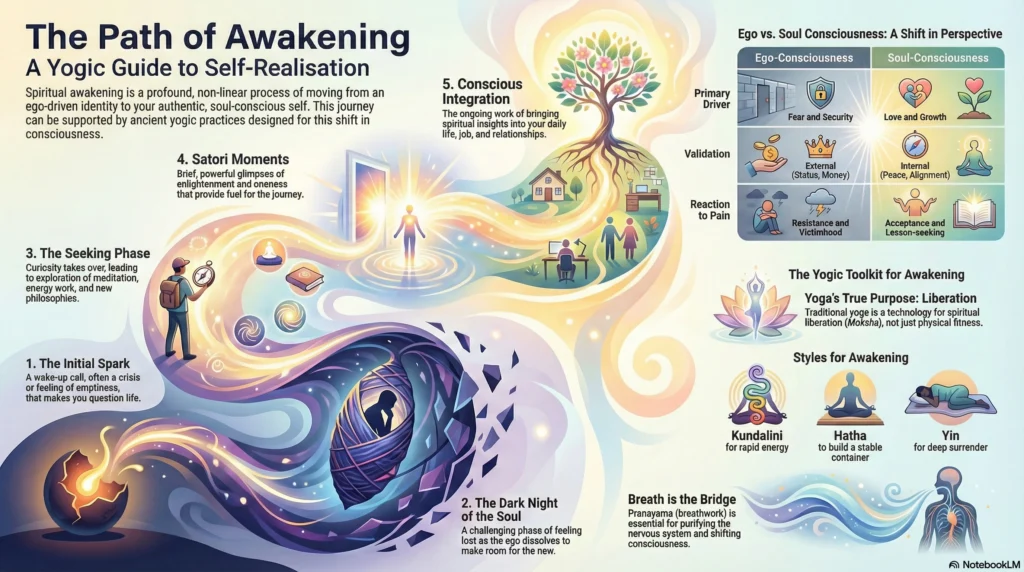
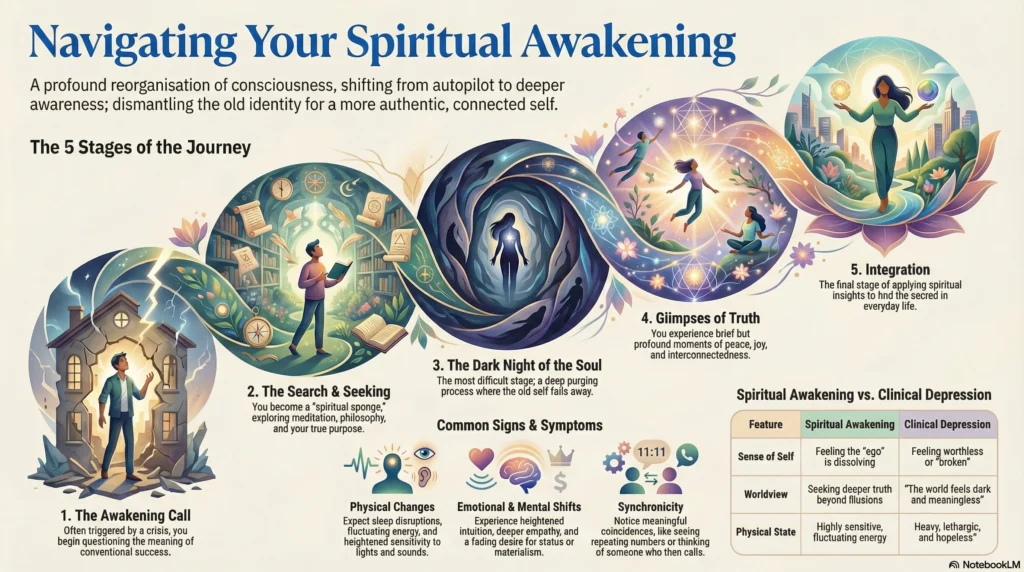
A spiritual awakening is often described as a “reorganization of consciousness”—a shift where you move from living on “autopilot” to a state of deeper awareness and connection. While the experience is unique to everyone, it generally follows a predictable pattern of dismantling the old self to make room for the new.
Stages of Spiritual Awakening
Most practitioners and psychologists who study this phenomenon identify several key stages. These are not always linear; you may cycle through them multiple times.
- The Awakening Call (The “Big Breakdown”): Often triggered by a crisis (loss, illness, or depression) or a sudden “aha” moment. You start to feel that society’s version of success is hollow and begin asking, “Is this all there is?”
- The Search & Seeking: You become a “spiritual sponge.” You might find yourself drawn to meditation, philosophy, or nature. You’re looking for answers to existential questions: “Who am I?” and “What is my purpose?”
- The Dark Night of the Soul: This is the most difficult stage. As your old ego-based identity falls away, you may feel lost, depressed, or completely alone. It is a “purging” process where you confront your deepest shadows and traumas.
- The Glimpses of Truth (Illumination): After the darkness, you begin to experience moments of profound peace, joy, and interconnectedness. These are brief periods where you feel “at one” with everything.
- Integration: The final and longest stage. You take the high-level spiritual insights and apply them to the “real world.” You learn to find the sacred in mundane tasks, like washing dishes or working your job.
Common Symptoms of Spiritual Awakening
Awakening affects you on three levels: physical, emotional, and mental.
Physical Symptoms
- Sleep Disruptions: Waking up consistently between 2:00 AM and 4:00 AM, or experiencing vivid, intense dreams.
- Sensory Sensitivity: Bright lights, loud noises, or crowded places become overwhelming. You may also find you can no longer tolerate certain foods (like processed sugar or meat).
- Tingling & Pressure: A common sensation of “vibrating” or pressure at the crown of the head or between the eyebrows (often associated with chakra activation).
- Fluctuating Energy: Periods of extreme, bone-deep fatigue followed by sudden bursts of creative energy.
Emotional & Mental Symptoms
- Heightened Intuition: You start “knowing” things without being told. You notice synchronicities—like seeing repeating numbers () or thinking of someone right before they call.
- Increased Empathy: You feel the pain of others and the planet more deeply. You may find it hard to watch the news or be around “toxic” or high-drama environments.
- Loss of Ambition: The desire for status, power, or “keeping up with the Joneses” fades. You crave authenticity and simplicity instead.
- A Sense of “Coming Home”: A feeling that you are finally returning to your true self, stripped of the masks you’ve worn for years.
Summary Table: Awakening vs. Depression
Because the symptoms can overlap, it is helpful to distinguish the two:
| Feature | Clinical Depression | Spiritual Awakening |
| Sense of Self | Feeling worthless or “broken” | Feeling the “ego” is dissolving |
| Worldview | The world is dark and meaningless | The world is an illusion; seeking deeper truth |
| Physical | Heavy, lethargic, hopeless | Highly sensitive, buzzing, fluctuating energy |
| Outcome | Withdrawal and stagnation | Transformation and eventual inner peace |
Note: If you are experiencing intense distress, it is always wise to consult a healthcare professional to rule out underlying medical or psychological conditions.
Dark Night of the Soul Phase
The “Dark Night of the Soul” can feel like being untethered from reality—as if the floor has been pulled out from under you. Grounding is the practice of pulling your energy out of the “spiritual clouds” (and the mental loops of the ego) and anchoring it back into your physical body and the physical world.
Here are the most effective grounding techniques specifically for this phase:
Physical “Earthing” (The Quickest Fix)
When your spirit feels like it is “hovering” outside your body, you need direct contact with the planet.
- The Barefoot Walk: Walk on actual grass, soil, or sand for 15 minutes. This creates a literal electrical exchange with the Earth that can stabilize your nervous system.
- The “Heavy Body” Exercise: Lie flat on your back on the floor (not a bed). Feel every point of contact your body makes with the hard surface. Visualize the floor supporting 100% of your weight so you don’t have to “hold” yourself up.
- Temperature Shock: Hold a piece of ice until it melts, or take a cold shower. The intense physical sensation forces your consciousness back into the “now” and out of existential dread.
Sensory Grounding (The 5-4-3-2-1 Method)
The Dark Night often involves “mental loops.” This technique breaks the cycle by engaging your five senses:
- 5 things you see: A specific leaf, a crack in the wall, the color of your pen.
- 4 things you can touch: The texture of your shirt, the cool metal of a watch, the grain of a wooden table.
- 3 things you hear: Distant traffic, the hum of a refrigerator, your own breath.
- 2 things you can smell: Coffee, old books, or even just the air.
- 1 thing you can taste: A piece of gum or a sip of water.
The “Chop Wood, Carry Water” Approach
In Zen tradition, the cure for spiritual overwhelm is mundane action. When the soul is in crisis, the ego tries to “think” its way out. Instead, do something physical and repetitive:
- Manual Labor: Garden, scrub the floors, fold laundry, or wash dishes by hand.
- Avoid “Over-Spiritualizing”: During a Dark Night, sometimes the best thing you can do is stop meditating and go watch a lighthearted comedy or eat a heavy, “root” meal (like potatoes or grains). This signals to your body that it is safe in the physical world.
Emotional “Holding”
- The Weighted Blanket: Many people in this phase feel a sense of “cosmic vulnerability.” A weighted blanket mimics the feeling of being held and can reduce the “buzzing” anxiety in the limbs.
- Weighted Visualization: Imagine thick, heavy roots growing out of the soles of your feet and deep into the center of the Earth. Visualize yourself as an old oak tree that cannot be blown away by the “wind” of your current emotions.
A Note on Surrender
The “Dark Night” is ultimately a process of letting go. The more you resist the feeling of being lost, the longer it tends to last. Grounding doesn’t make the “Night” go away, but it gives you a sturdy lantern to carry while you walk through it.
Shadow work is the practice of exploring the “hidden” parts of yourself—the traits, memories, or impulses that you’ve repressed or denied. During a Dark Night, these shadows often bubble to the surface, which is why the experience feels so heavy.
Instead of pushing them back down, use these prompts to shine a light on them. I recommend writing your answers by hand to help move the energy out of your head and onto the paper.
Prompts for Hidden Emotions
- The Forbidden Feeling: “What is an emotion I rarely allow myself to feel (e.g., anger, jealousy, deep sadness)? Why did I decide this emotion was ‘bad’ or ‘unsafe’?”
- The Projection Mirror: “Think of someone who deeply irritates or triggers you. What specific trait do they have that you refuse to see in yourself?”
- The Mask: “What is the biggest lie I tell others about how I am doing? What would happen if I stopped pretending?”
Prompts for Reclaiming Power
- The Inner Child: “Visualize yourself at age 7. What did that child need that they didn’t get? How can I provide that for myself today?”
- The Self-Judgment: “When I am being self-critical, whose voice is actually speaking? (Is it a parent, a teacher, or a past partner?) What does my own voice want to say in response?”
- The Void: “If I lost my job, my titles, and my external achievements tomorrow, who would be left? What parts of me are ‘permanent’?”
Understanding the Process
Shadow work isn’t about “fixing” yourself; it’s about integration. You are bringing the fragmented pieces of your identity back into a single, whole person.
Tips for Safe Shadow Work
Because this can be emotionally taxing, please keep these “safety rails” in mind:
- Limit Your Time: Don’t spend more than 20–30 minutes on these prompts at a time. It’s deep work, and you need time to recover.
- Be Compassionate: Approach yourself like a curious observer, not a judge. There are no “wrong” answers.
- After-Care: After a session, do one of the physical grounding techniques we discussed earlier—like eating a warm meal or taking a walk—to settle your nervous system.
Again Note: Consult a healthcare professional to rule out underlying medical or psychological conditions if you are unsure regarding what is happening.
Leave a Reply