There are rare mornings when the world briefly stops pretending to be made of separate things. Perhaps it occurs during a quiet walk in the woods or in a sudden pause amidst the cacophony of a city street—a momentary glitch in perception where the distinction between “here” and “there,” “self” and “other,” dissolves into a wordless sense of unity. Most of us dismiss these flashes as mere trickery of the mind, a fleeting sentimentality to be ignored once the coffee kicks in and the day’s fragmented tasks resume.
But David Bohm did not dismiss them. He spent his life proving they were glimpses of the truth.
Bohm did not reside in the hazy periphery of the New Age; he was forged in the intellectual crucibles of Berkeley and Princeton. A protégé of Robert Oppenheimer and a close partner to Albert Einstein, Bohm was a rising titan of 20th-century physics until he was caught in the gears of the Cold War.
In 1949, the House Un-American Activities Committee (HUAC) demanded he betray his colleagues. Refusing on principle, Bohm was arrested and eventually acquitted by the courts—yet, in a bitter irony, he was condemned by the institution. Princeton declined to renew his contract, and the United States government confiscated his passport.
Exiled from his home and the scientific establishment, Bohm found himself stripped of institutional orthodoxy. It was in this state of forced isolation that he began to look beneath the surface of reality to find a hidden, undivided wholeness that his peers had overlooked.
The Illusion of the Ink Drop
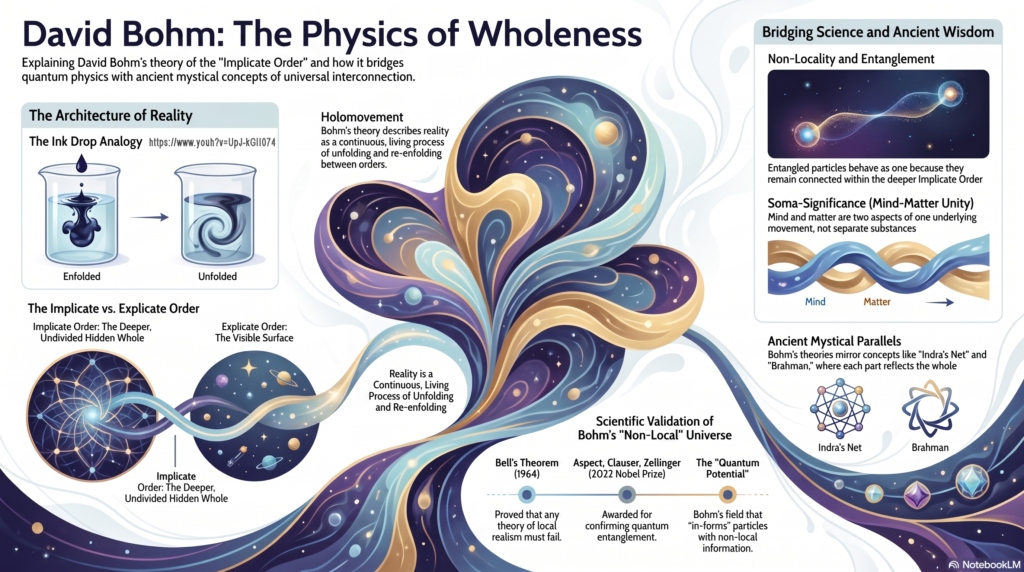
To illustrate the deceptive nature of reality, Bohm favored a particular demonstration involving two clear, nested cylinders with a thick, syrupy fluid between them. When a drop of ink is placed in the fluid and the inner cylinder is rotated, the ink stretches, thins, and eventually disappears. To the casual observer, the order of the ink drop has been destroyed, rendered into a state of chaos.
However, the miracle occurs when the rotation is reversed. As the crank turns back the exact same number of times, the invisible thread of ink begins to gather, thickening and reassembling until the original drop reappears precisely as it was.
The order was never destroyed; it was enfolded.
Bohm used this to define two fundamental levels of existence. The “Explicate Order” is the unfolded surface we perceive—the world of separate objects and distinct events in space and time. Beneath it lies the “Implicate Order,” a non-local depth where everything is enfolded into everything else. He viewed the relationship between these two as a continuous, living process:
“The movement between them—the constant unfolding and re-enfolding—is the ‘holomovement.’ It is not a thing, but a process; a living, flowing totality that can never be fully captured by any fixed description.”
In this view, an electron is not a “thing” bouncing through a vacuum. It is a pattern appearing and disappearing within the holomovement, much like the ink drop, guided by a hidden geometry that is stored in the very fabric of reality even when it cannot be seen.
Why Separation is a Mathematical Myth
Bohm’s insights were not merely poetic; they were anchored in rigorous mathematics. In 1952, he reformulated quantum mechanics through his “pilot-wave theory.” While the standard Copenhagen interpretation suggested that particles are essentially ghostly and indeterminate until measured, Bohm argued that they have definite positions at all times, guided by a “quantum potential.” This potential carries information about the entire system instantaneously, regardless of distance.
In Bohm’s framework, “non-locality”—the “spooky action at a distance” that so troubled Einstein—is not a paradox. It is a natural consequence of a universe that was never truly divided. If two particles are entangled across the galaxy, they don’t need to signal each other because, in the implicate order, they are still the same “drop.”
This prophetic stance was validated decades later. John Bell, inspired by Bohm’s 1952 papers, developed the theorem that allowed physicists to test whether “local realism” was a tenable description of our world. The answer arrived definitively in the 2022 Nobel Prize in Physics, awarded to Alain Aspect, John Clauser, and Anton Zeilinger. Their experiments confirmed the violation of Bell inequalities, effectively proving that the universe is fundamentally non-local.
Bohm warned that our stubborn insistence on seeing the world as a collection of separate fragments is the root of our greatest sorrows:
“The notion that all these fragments are separately existent is evidently an illusion, and this illusion cannot do other than lead to endless conflict and confusion.”
Soma-Significance: The Mind of the Electron
Bohm’s most radical leap was the suggestion that consciousness is not an accidental byproduct of biology, but a fundamental property of the universe. He coined the term “soma-significance” to describe the relationship between matter (soma) and meaning (significance).
He argued that mind and matter are not two different substances, but two aspects of the same underlying movement. Just as the quantum potential “in-forms” (gives form to) the movement of a particle, meaning in-forms the movement of matter. For Bohm, meaning was a fundamental force of nature.
“Consciousness,” he noted, “is much more of the implicate order than is matter.” This led to his provocative and deeply logical claim: “Even the electron is informed with a certain level of mind.” If information guides the physical world at its most basic level, then the universe is more like a great thought than a great machine.
The Architecture of the Ancients
While Bohm arrived at his conclusions through wave equations, he was struck by the fact that ancient mystical traditions had arrived at the same mathematical topology through contemplative insight. Whether in dialogue with the philosopher Jiddu Krishnamurti or acting as the Dalai Lama’s “science guru,” Bohm saw his physics as a modern map of an ancient territory.
The parallels are more than metaphorical; they are structural:
- Vedanta: The Mandukya Upanishad describes Brahman as the infinite, unchanging ground of reality, while the manifest world is Maya—the surface appearance mistaken for the depth. This mirrors Bohm’s distinction between the Implicate and Explicate.
- Taoism: The opening of the Tao Te Ching speaks of a Tao that cannot be named, mirroring Bohm’s “holomovement,” which he described as “undefinable and immeasurable.”
- Buddhism: The Avatamsaka Sutra offers the image of Indra’s Net, an infinite cosmic web where each jewel reflects every other jewel. Each “enfolded region” of Bohm’s reality contains the whole, just as each jewel in the net mirrors the totality.
The Remedy for a Fragmented World
We currently live in an age of extraordinary fragmentation—political, psychological, and ecological. Our languages and education systems are designed to reinforce duality: me versus you, mind versus matter, observer versus observed.
Bohm argued that this duality is not an inherent feature of reality, but a feature of our thinking about reality. We have mistaken the map for the territory, and in doing so, we have blinded ourselves to the “unbroken movement” that holds us. The remedy for our global crisis, Bohm suggested, is a return to the recognition of our fundamental unity.
“Deep down the consciousness of mankind is one. This is a virtual certainty because even in the vacuum matter is one; and if we don’t see this, it’s because we are blinding ourselves to it.”
Beyond the Map
David Bohm’s life and work serve as a reminder that the world of names, boundaries, and separate objects is never the whole truth. It is a useful shorthand, but it is not the ground of being. We are participants in a grand, unfolding dance—a single, undivided whole that is constantly enfolding and reappearing in new forms.
As we face a world fractured by the illusion of separation, we might ask: If you were to truly accept that every “separate” person, every “other” object, and every “isolated” event in your life is actually an expression of the same undivided whole, how would that change the way you move through the world today?