A Guide to the Path of Inner Transformation
In the modern world, many begin their yoga journey seeking physical fitness or stress relief. However, for many practitioners, there comes a moment when the practice shifts from a workout to a “work-in.” This transition is often the start of Spiritual Awakening Yoga, a process where the physical postures (asanas) become a gateway to profound self-discovery and consciousness transformation.
What is Spiritual Awakening in Yoga?
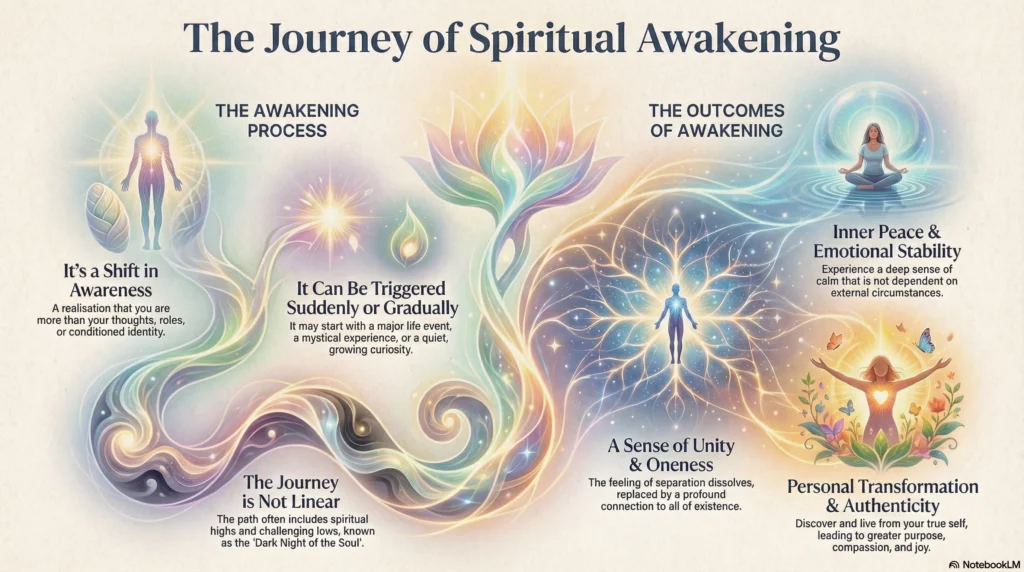
Rooted in ancient Indian philosophies such as Vedanta, Samkhya, and Buddhism, yoga was originally designed as a vehicle for spiritual liberation. Within this framework, a “spiritual awakening” is the realization that the separation between the self and the universe is an illusion.
In the context of yoga, awakening is not a literal external destination but an inner journey. It involves:
- The Union of Consciousness: The word yoga itself comes from the Sanskrit root yuj, meaning “to yoke” or “to unite”—specifically joining the individual soul (Atman) with universal consciousness (Brahman).
- A Shift in Perception: Moving from an ego-centered view of life to one rooted in compassion, empathy, and interconnectedness.
- Physical and Energetic Realignment: Using the body as a scaled representation of the universe to unlock deeper levels of awareness.
The Stages of the Spiritual Path
A spiritual awakening through yoga rarely happens overnight. It is often described as a series of stages that reorganize how we perceive reality:
- The Call (Initial Dissatisfaction): A quiet sense that life—or your current physical yoga practice—no longer feels “enough.” You may feel a longing for deeper meaning.
- The Dark Night of the Soul: A period of intense questioning or “shadow work” where old identities and beliefs begin to crumble.
- The Awakening (The Dawn of Insight): Moments of clarity where you begin to feel a sense of oneness and bliss emanating from your practice.
- Integration: Learning to bring these expanded states of awareness into your everyday life and relationships.
Practices to Support Your Awakening
To transition your practice toward a spiritual focus, consider incorporating these elements into your routine:
- Brahma Muhurtham (Early Morning Practice): Waking up between 3:30 a.m. and 5:00 a.m. is traditionally considered the most potent time for spiritual work, as the mind is naturally at a more conscious “alpha” frequency.
- Pranayama (Breathwork): Moving beyond the physical requires mastering the breath to influence the movement of Prana (life force energy).
- Meditation and Stillness: While asanas prepare the body, meditation is the primary tool for shattering old patterns and confronting deep-seated beliefs.
- Chakra Balancing: Focusing on the body’s energy centers to facilitate the natural awakening of Kundalini energy.
Signs You Are Experiencing a Spiritual Shift
As you deepen your practice, you may notice “symptoms” of awakening that go beyond the yoga mat:
- Heightened sensitivity to your surroundings.
- Changes in sleep patterns, such as naturally waking up in the early morning hours.
- A growing desire for authenticity and a feeling that old habits or relationships no longer align with your truth.
- Increased feelings of universal love and empathy for all living beings.
People Also Ask Regarding: Spiritual Awakening Yoga
- What is a spiritual awakening in yoga? In yoga, a spiritual awakening is the realization of the union between the individual soul (Atman) and universal consciousness (Brahman). It is a shift in perception where the illusion of separation dissolves, leading to heightened states of compassion and awareness.
- What are the signs of a yogic spiritual awakening? Common signs include a natural shift in sleep patterns (waking between 3–5 AM), increased sensitivity to energy, a deep longing for authenticity, and a transition from seeing yoga as a workout to seeing it as a “work-in.”
- Can yoga cause a “Dark Night of the Soul”? Yes. As yoga helps practitioners shed old identities and ego-based beliefs, it can trigger a “Dark Night of the Soul”—a period of confusion or destabilization that often precedes a major spiritual breakthrough.
FAQ for: Spiritual Awakening Yoga
Q: Is “Spiritual Awakening Yoga” a specific style like Hatha or Vinyasa? A: Not necessarily. While some styles (like Kundalini or Integral Yoga) focus more heavily on spirituality, “Spiritual Awakening Yoga” refers more to the intent of the practitioner. It is the application of traditional yogic philosophy—such as the Eight Limbs of Patanjali—to any physical practice to achieve self-realization.
Q: Why is waking up at 3:30 AM (Brahma Muhurtham) important for this path? A: Traditional Vedic scriptures suggest that the time between 3:30 and 5:00 AM is the most potent for spiritual work. During these hours, environmental and noise pollution are at their lowest, and the brain naturally functions at an “alpha” frequency, making it easier to access deeper states of consciousness.
Based on the comprehensive research notebook provided, here is the SEO metadata and secondary content structured to maximize topical authority for the keyword “Spiritual Awakening Yoga.”
Summary: Yoga as a Lifelong Journey
Spiritual Awakening Yoga is more than a style of practice; it is a lifestyle shift from the physical to the metaphysical. Whether you are navigating the “Dark Night of the Soul” or experiencing your first glimpses of inner peace, remember that yoga is a comprehensive path to self-realization that has been preserved for thousands of years to guide us home to ourselves.
Pingback: Yoga Beyond the Mat: A Modern Guide to Spiritual Awakening
Waking Up to Reality https://www.youtube.com/watch?v=zlmoYFaj5oU