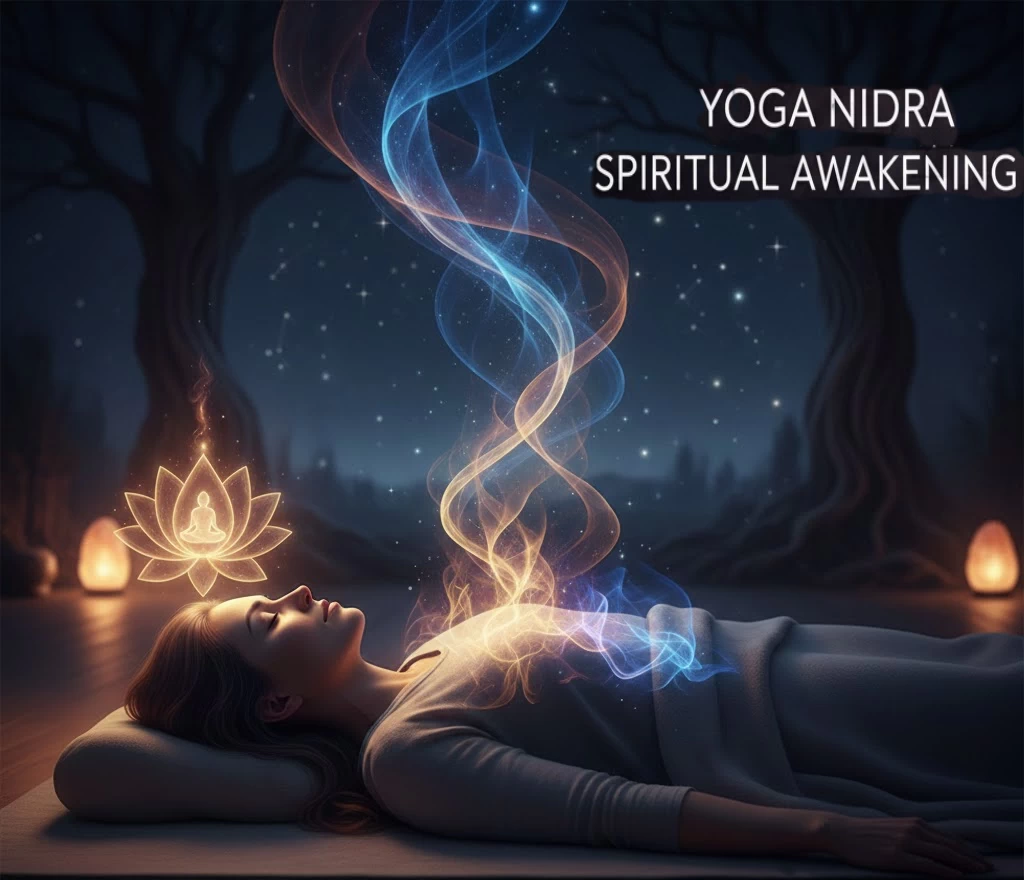
1.0 Introduction: Defining “Yogic Sleep”
Yoga Nidra is far more than a simple technique for relaxation; it is a profound meditative practice that offers a direct path to deep, restorative states of being. For instructors seeking to guide students beyond conventional meditation, understanding its principles is paramount. This manual provides the foundational knowledge to facilitate experiences that are not only calming but truly transformative.
Commonly referred to as “Yogic Sleep,” Yoga Nidra is a unique state that intentionally bridges the gap between biological sleep and conscious awareness. Its primary function is to systematically trigger the body’s Relaxation Response, a term coined by Harvard cardiologist Herbert Benson to describe the physiological counterpoint to the stress response. By consciously guiding the body and mind into a state of profound rest, we can neutralize the chronic effects of stress. This manual will explore the underlying physiological mechanisms that make this ancient practice so effective in the modern world.
2.0 The Foundational Science: From Stress to Deep Relaxation
A skilled instructor’s ability to articulate the “why” behind Yoga Nidra is as important as guiding the “how.” Understanding the distinct physiological and neurological shifts that occur during the practice empowers you to explain its benefits with clarity and authority. This knowledge transforms the practice from a mystical experience into a tangible, science-backed methodology for well-being.
2.1 The Autonomic Nervous System: A Balancing Act
As instructors, our primary role is to teach students how to consciously influence the seesaw-like balance between the two branches of the Autonomic Nervous System. Yoga Nidra is a tool for consciously tipping the scales away from stress and toward restoration.
| State & Nervous System Branch | Physiological Effects |
|---|---|
| Stress Response (Sympathetic “Fight or Flight”) | Increased cortisol, high heart rate, shallow breathing, muscle tension. |
| Relaxation Response (Parasympathetic “Rest and Digest”) | Lowered blood pressure, slowed heart rate, increased Heart Rate Variability (HRV), and tissue repair. |
The primary objective of Yoga Nidra is to guide the practitioner into a state of conscious deep sleep. This is achieved by systematically slowing the frequency of brainwave activity, allowing one to remain alert while accessing the profound restorative benefits typically available only during unconsciousness. The journey unfolds across the following states:
• Beta Waves (12–30 Hz): This is our normal waking consciousness, associated with logic, active thinking, and often, stress.
• Alpha Waves (8–12 Hz): This is the bridge to deeper states, often experienced during light meditation and moments of relaxed focus.
• Theta Waves (4–8 Hz): A state of deep meditation and dreaming, this frequency provides access to the subconscious mind.
• Delta Waves (0.5–4 Hz): The frequency of deep, dreamless sleep.
The practice of Yoga Nidra involves learning to “hover” at the threshold of the Delta state. The significance of this state is profound; it is where the body engages in its most powerful healing and memory consolidation. By remaining consciously aware here, the practitioner can effectively clear subconscious “clutter,” known in yogic philosophy as Samskaras, which often fuels chronic stress patterns. This unique ability to remain aware during deep physiological rest is what fundamentally separates Yoga Nidra from ordinary sleep.
3.0 Distinguishing Yoga Nidra from Conventional Sleep
It is crucial for instructors to clearly articulate the unique advantages of Yoga Nidra when compared to conventional sleep. This distinction elevates the practice in the student’s mind from a simple nap to a targeted and powerful therapeutic tool. While both involve rest, their nature and outcomes are fundamentally different.
3.1 The Power of Conscious Restoration
Yoga Nidra offers a uniquely efficient mode of recovery. Practitioners often cite a powerful equivalence: one hour of Yoga Nidra can feel as restorative as 3–4 hours of conventional sleep. The reason for this heightened efficiency lies in its directness. The practice systematically bypasses the often-restless “tossing and turning” of the dreaming mind (a feature of normal sleep cycles) and guides the practitioner straight to the physiological “reset” button of deep, dreamless rest.
3.2 The Role of the Sankalpa: Intentional Reprogramming
A key differentiator from sleep is the use of a Sankalpa—a short, positive resolve or intention stated at the beginning and end of the practice. While ordinary sleep is a passive experience where we are subject to the whims of our dreams, Yoga Nidra is an active and intentional process. In the highly receptive Theta/Delta brainwave state, the mind is fertile ground for new ideas. The Sankalpa leverages this receptivity to gently “re-program” deep-seated habits and conditioned responses to stress, planting a seed of positive change at the subconscious level. This intentional programming is made possible through the systematic methodology of the practice itself, which reliably guides the practitioner into this receptive state.
4.0 The Method: A Practical Guide to Facilitation
The profound power of Yoga Nidra lies in its systematic, accessible methodology. It does not require years of difficult concentration but instead offers a clear roadmap for guiding students from the friction of mental activity to a state of profound inner stillness. The following steps provide the core framework for this guided journey.
4.1 The Core Technique: Rotation of Consciousness
The “sleepless sleep” of Yoga Nidra is achieved through its core technique, a systematic Body Scan often referred to as the Rotation of Consciousness.
1. Preparation: Instruct the student to lie in Savasana (Corpse Pose) in a quiet and comfortable environment.
2. The Rotation: Guide the student’s attention through the body by naming specific parts in a structured sequence (e.g., hands, fingers, thumbs, wrists, etc.). The student’s only task is to mentally touch each part as it is named. The neurological impact is key: this simple act “occupies” the brain’s motor cortex, preventing it from engaging in its habitual, and often stressful, thought loops.
3. The Threshold: As the practice deepens, the student may report sensory signals indicating they have reached the Delta/Deep Sleep state while maintaining awareness. Common experiences include the body feeling as though it has “disappeared,” become intensely heavy, or is floating. This is the sign that the mind has become a “silent witness” to the body’s deep rest.
Note for Instructors: It is common for students, especially beginners, to fall into biological sleep. If you hear snoring or notice a student has lost the thread of your guidance, they have simply crossed the threshold into unconsciousness. Reassure them that this is a natural part of the process. The ability to balance on the fine line between conscious rest and unconscious sleep develops with consistent practice.
4.2 Moving Beyond the “Thinking Mind”
Most of our waking life is spent in the Beta brainwave state, a state dominated by the mind’s constant narration, labeling, and judgment. We often mistakenly identify this internal monologue as our true self. Yoga Nidra offers a direct method for disengaging from this narrative.
The “rotation of consciousness” facilitates a non-verbal shift. By guiding awareness from one point to the next, the verbal, narrating mind is given no space to engage and eventually gives up trying. The result is a profound shift in perception: the student stops thinking about the body and starts experiencing it as a field of pure sensation. This practical technique serves as the gateway to the deeper philosophical journey it facilitates.
5.0 The Philosophical Anatomy: Experiencing Your True Nature
Yoga Nidra is more than a physiological process; it is a practical application and direct experience of core tenets within yogic philosophy. Understanding this deeper framework allows an instructor to guide students not just toward relaxation, but toward a powerful experience of self-realization. The practice is a journey inward, through the layers of our perceived identity to the silent core of our being.
5.1 Relaxing out of the Layers: The Five Koshas
Yogic philosophy describes our being as comprised of five nested layers, or sheaths, known as the Koshas. Yoga Nidra works by systematically quieting each of these layers to reveal the one without edges or boundaries moving from the gross to the subtle.
1. Annamaya Kosha (Physical Body): This layer is relinquished through the practice of deep stillness in Savasana.
2. Pranamaya Kosha (Energy Body): This layer of vital force is settled through gentle awareness of the breath.
3. Manomaya Kosha (Mental Body): The layer of the lower mind and processing thoughts, quieted by witnessing thoughts arise and pass without engagement.
4. Vijnanamaya Kosha (Wisdom Body): As the mental chatter subsides, this layer of higher intellect and witness consciousness is accessed.
5. Anandamaya Kosha (Bliss Body): This is the core of our being, the final layer revealed when all others are still.
When the first four layers are transcended, one comes to rest in the Anandamaya Kosha. It is crucial to clarify that this “bliss” is not an emotional high or a fleeting feeling of happiness. Rather, it is a profound and silent “OK-ness”—a fundamental sense of peace that exists independently of our thoughts, emotions, or external life circumstances.
5.2 The Ultimate Goal: Turiya, The Fourth State
The traditional aim of Yoga Nidra is to experience a state known as Turiya. In Indian philosophy, consciousness is generally understood through three familiar states: Waking, Dreaming, and Deep Sleep. Turiya is described as the “fourth state”—it is not a separate state to be achieved, but rather the background of pure, constant awareness that exists throughout and beyond the other three. It is the screen on which the movies of waking, dreaming, and sleeping play out.
The direct experience of Turiya in Yoga Nidra can be synthesized as follows:
• Thought-Free Awareness: You are physiologically in the “Deep Sleep” state, with brain activity dominated by Delta waves, but your awareness remains “on” and fully present.
• The “I AM” Experience: In this profound stillness, all verbal descriptors that define your identity—your name, job, history, and relationships—fall away. What remains is a raw, non-verbal, direct experience of existence itself.
This is the experience of the “true nature of being”—the silent witness that remains when everything else is stripped away.
6.0 Summary: The Paradox and the Promise
The ultimate teaching of Yoga Nidra is delivered not through words, but through direct experience. It reveals a fundamental paradox: you are not the “stresser” who is anxious about life, nor are you the “relaxer” who is effortfully trying to find peace. You are the silent, unchanging space in which both the phenomenon of stress and the phenomenon of relaxation occur.
By learning to rest as this thought-free space, the nervous system is freed from the constant “whiplash” of the ego’s demands and anxieties. In this stillness, it recalibrates and heals itself. This is the profound promise of the practice—a return to our intrinsic wholeness.
“Peace beyond words, transcendental sleep, and extraordinary happiness—these point to Yoga Nidra as more than a practice; it is a homecoming.”
“Peace beyond words, transcendental sleep, and extraordinary happiness—these point to Yoga Nidra as more than a practice; it is a homecoming.”

Leave a Reply